Showing posts with label science. Show all posts

Wednesday, August 27, 2008

The Lost Ladybug Project


I was researching a different topic when I stumbled across the Lost Ladybug Project. Here in Michigan we have been so overrun by the ladybug's stinky brown cousins, the asian beetle, that most of us haven't noticed that the classic ladybug is no longer around.
Besides being incredibly cool and charismatic ladybugs are also essential predators in both farms and forests that keep us from being overrun with pests (like aphids and mealybugs). In many areas the native ladybugs are being replaced by exotic ones. This has happened very quickly and we don’t know how this shift happened, what impact it will have (e.g. will the exotic species be able to control pests as well as our familiar native ones always have) and how we can prevent more native species from becoming so rare.
Cornell University is asking for help from the citizen scientist community to find out what's going on. The Lost Ladybug Project asks us to watch for ladybugs and, when we find them, photograph them and upload the photos and other information to their database. Anyone can do this; you can read here about the elementary school kids who made the first sighting in 14 years of a nine-spotted ladybug in the eastern US. There are clear instructions and a map of others' sitings on the website.

I think I've seen some nine-spot and two spot ladybugs in the last few years, but I wasn't thinking of them as a nearly extinct species or I would have paid more attention. The lovely ladybug is a reminder to me to slow down and pay attention to the little lovely details of my days.

Thursday, December 14, 2006

The War on Science Grinds On

I didn't join in the rejoicing after the Democrats took back Congress. Sure, I was glad, but our troubles are far from over. The nation will soon find out what it's like to be Michigan in the post-Republican hangover period. Our economy is shot, our state coffers are empty, our schools are failing, the ex-governor who ran the state into the ground ids now a lobbyist in Texas. It's like the morning after the wild party: as long as the booze and food were free you had lots of friends, but now that it's time to clean up you're all alone. And broke. And out of trash bags.

The rest of the country may not realize that getting rid of the neocons is not enough. We're still going to have to clean up after them, and pay the bills for all they stole.

But some things can get better right away. This article about the censorship of science is a prime example:
The Bush administration is clamping down on scientists at the U.S. Geological Survey, the latest agency subjected to controls on research that might go against official policy.

New rules require screening of all facts and interpretations by agency scientists who study everything from caribou mating to global warming. The rules apply to all scientific papers and other public documents, even minor reports or prepared talks, according to documents obtained by The Associated Press.

This sort of stuff irritates me to no end. I am interested in the process of science, not just the results, and if you don't "show your work", including all of the hypotheses that didn't prove true, you ain't doing science.

I can only imagine what the last six years might have been like if we had a president who was more familiar with the Scientific Method. Or one who was interested in a dialogue of competing ideas. Or one who censors policies to suit the results, instead of vica-versa.

Tuesday, April 04, 2006

The Magic School Bus

I'm adding a new blog to my list. The Magic School Bus is about science education, written by Bora Zivkovic, who teaches biology lab to college students in Chapel Hill, North Carolina. I particularly liked this account of using the process of putting together a jigsaw puzzle to illustrate the scientific method:
So, what are you doing first? Looking at the pieces - that is observation. You still have absolutely no idea what the Big Picture is going to be, but you are looking for a good starting point, so you are soaking in all the information that you can glean from all the jumbled pieces on the table. So you are taking prior knowledge and using it to make sense of observed phenomena.

What are you doing next? You are trying to put some pieces together. Those are experiments. Every time you pick up two pieces and try to put them together you are testing a hypothesis - that the two pieces will fit. Most of the time your experiment fails at the first try, so you try again by rotating the pieces a little bit at a time and trying again. If it does not work, you drop the pieces and leave them for later, as obviously you need additional information. If it works, you publish your findings in a scientific journal and move on to the next hypothesis.

I see that different people have different approaches. Some look for edge pieces and try to put them together. Others are looking for any two pieces that may have shape, color and pattern similar enough that they may fit together, yet others are looking for key pieces - those with most interesting pieces of information, like an eye or a nose.This is just like personal styles of different scientists. Some start with easily gleaned information - the edges - and systematically build on it, piece by piece. They know that this approach is slow and tedious, but will certainly, over time, build the whole picture. Others do something more risky - go for the most interesting information although it is difficult to study it or to place it in a broader context. They are more likely to fail, but if they get it right, the returns on the investment are enormous - they have figured out what the big picture is going to be without doing all the detailed boring work............... Read more here.

Go ahead and read the whole piece, especially if you don't think of yourself as a scientist. Or maybe I should say "especially if you're a journalist." Journalism and science see to be butting heads a lot lately, on everything from cholesterol advice to bird flu to climate change. Journalists want the whole story now. Scientists know the story isn't whole, yet, and they reserve the right to revise the story as new data comes in. Just like working a puzzle.

Friday, March 31, 2006

Avian Flu and Intellectual Property

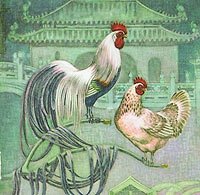
Illustration of a Pheonix breed rooster and hen
Data hoarding continues to impede avian flu research. While many samples of the virus have been collected and genetically sequenced, the researchers, labs and nations involved have been reluctant to make this information public.

Everyone hopes to be the first to win fame and fortune as the developer of the first avian flu vaccine, the patent-holder on the next flu drug, or even the genetic engineers of the flu-resistant chicken.

The chicken engineers are thinking big. Just look at this quote from the UK Times:

Even if the technique works, it will be several years before it can be used to stock farms and it also faces important regulatory hurdles and a battle to win over public opinion. If these obstacles are overcome and farmers are willing to adopt GM chickens, the entire world stock could be replaced fairly quickly.

Once we have regulatory approval, we believe it will only take between four and five years to breed enough chickens to replace the entire world population, Professor Tiley said. Developing flu-resistant chickens has clear benefits for human health and animal welfare, as we wouldn't have to slaughter chickens around the world. Chickens provide a link between the wild bird population, where avian influenza thrives, and humans, where new pandemic strains can emerge. Removing that bridge will dramatically reduce the risk posed by avian viruses.


Wow. Replacing the world's mind-boggling diversity of chicken breeds with a few genetically-engineered breeds.

One of our favorite pastimes this time of year is catalog shopping for chicken breeds. We get the catalog from Murray McMurray Hatcheries and weigh the strengths and weaknesses of various breeds. Some are bred for egg laying, some are bred for meat, some are old fashioned "dual purpose" birds. Some are known for temperment, important if you have a small yard and close neighbors. Some have retained "broodiness", the instinct to set on eggs and raise chicks that has been discouraged in lines bred strictly for egg laying. There are fancy breeds, blue egg layers, Polish crested chickens, and feather footed cochins.

So many chickens! Some breeds are foragers, ready to go out in the world and scratch for their dinner. Some are bred to just hang around and pump out eggs. Some are smart enough to roost in the trees at night. Some have had the sense bred out of them; they just huddle on the ground and wait to be eaten.

Each breed is the result of generations of breeding. I suspect the smarter, thriftier birds are the result of breeding that spans human generations, not poultry generations. There are countless more varieties of chickens, a different variety living in each little corner of the world, bred for centuries to best suit the microclimate and needs of the people who live there.

This is the old-fashioned method of genetic engineering: selective breeding and cross breeding to secure the traits that are favored. In good times, you might breed for a fancy tail. In bad times you might breed for survival in famine or resistance to the latest disease.

Now, confident that the only answer is in gene splicing, we are depopulating the countysides of their locally-bred chickens, in a losing battle to contain the virus. The disease is devastating to flocks; the birds look fine one day and the next morning 80 to 90% are dead. One wonders if the clue to flu resistance in poultry lies in that small sliver of surviving birds, the ones that are being culled with the rest. Or maybe it lies with the flock next door that appeared untouched by the disease but was culled anyway.

The first images of avian flu showed us armloads of chickens, held upside down by their feet, on the way to incineration. As someone who has catalog shopped chicken breeds, I wanted to shout: "Wait! What kind of chicken is that? Show me again, right side up! What a cool bird!"

But it was gone. Not just from my TV screen, but probably from the face of the earth.

Some people's intellectual property lies in their lab. Some people's intellectual property scratches and clucks out in the yard. How odd that we allow lab-base intellectual property to be hoarded, to the detriment of mankind, while barnyard-based intellectual property is tossed on the burn-pile?