Tuesday, November 01, 2005

The Halloween Post

This is Anna's pumpkin, a cat-o-lantern carved from the "Chat Noir" poster that Shelagh left behind when she went to school. Anna drew the design and I carved it for her. The photography looks a little odd because I didn't drag the tripod out, but I like it. It's a nice opening for the Halloween Report:


It was a beautiful night, about 50 degrees and still. Anna was dressed as an "Adorable Witch", a store bought costume that seemed to answer her need to be a not-very-ugly, not-very-scary witch. (Her first choice was to be a teenager, but I told her to pick something else, as we certainly had enough of those around already.) She came home from the school dressup party with a monstous amount of makeup on. I snapped this picture to show her how silly she looked, but seeing the picture only made her love the makeup more.

I was reminded of how, before I had teenagers, I used to think that middle school kids had stopped putting energy into dressing up for Halloween and were only out for candy. When I actually had kids that age, I found that they put enormous amounts of energy into their costumes. But their energy was spent on making sure that they wouldn't look silly, or uncool, or draw undue attention to themselves -- kind of the opposite of what the rest of the world thinks of Halloween. In the end, when Shelagh and Liz were middleschoolers, every girl tried to look like Britney and ended up looking slutty. I'm not sure what the boys were trying to do, but they ended up looking like muggers.

This year Liz and her friends went trick-or treating, even though they are seniors, with their friends in Suttons Bay. Liz was a fireman, Mary was a ninja, and Ellen was a gorilla. They no longer worry about looking foolish or transforming themselves into whatever their psyches need; they just grab whatever costume is available and go.

I had dressed as the chessboard's Black Queen for Friday's Halloween concert and Saturday's Halloween party at the casino. After 10 hours being the Queen on her feet I was ready to go trick or treating as Mom.

There were plenty of other participating adults. Some came to the door in costume, some walked the streets with their kids. We went to Lake Leelanau first. It was quiet there, with groups of people making their way through the unraked leaves. Richard and I move in different circles, but between the two of us we know almost everyone. I would say hi to one group of people, and he would turn out to be best buddies with the next guy.

Later we met up with some of Anna's friend in Leland. She was much happier to be trick-or-treating with friends, but Richard and I kept stopping to talk with people and falling behind. I accepted a beer from one house and then walked with it concealed in my coat, stopping to sip in the dark spots between streetlights. Some streets were lit up with lots of people hosting trick or treaters. Some were nearly dark, with only a house or two. Down one dark cul-de-sac was a lone house with a long sidewalk lined with juniper bushes. As the kids walked up to the house, people hidden in the bushes grabbed at their feet. When we left the house, in the dark, it took some time to notice the black-clad figure pacing to steps behind us, eavesdropping. As soon as we saw it, the person took off and faded into the dark.

Richard had been giving me a running commentary on the recent construction in the village, who had built what and which places he had worked on. On a whim, we walked up to Telgard's, a house he had worked on a few years ago, but had never seen finished. They were happy to give an impromtu house tour. It was built around the same time as ours, but is a large "town home" as opposed to our smaller and more utilitarian farm house. They didn't just remodel, they restored it as much as possible and it looks nice.
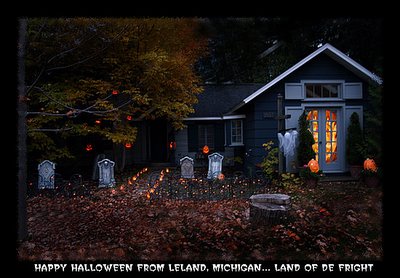


This image (courtesy of the Leland Report) shows the last stop of the night's trick or treating venture. Lori has hosted a Halloween party every year since Shelagh and Liz were toddlers. Some years it is the warming-up stop, where we can thaw out our fingers in front of her fire. We ate sloppy joes and cookies while the kids compared candy bags.

On the way to Lori's we passed the "All Saints Party" at the Old Art Building. A few years ago the Art Building hung Halloween decorations including a witch from a tree out by Main Street. The Lutherans lodged a protest, saying that this was promoting evil. This year they rented the building and hosted an alternative to trick-or-treating. Many kids just double dipped, first trick-or-treating then attending the party. As we walked by, it looked too well lit. The rented blow-up trampoline full of balls looked sad and boring, compared to the wonder of wandering the night and seeing dark shapes that turned out to be friends.

There were a few kids who didn't attend the school Halloween concert, either, because their parents think that Halloween is the work of the devil. I liked the article in Christianity Today, Hallowing Halloween. The author promotes Halloween as a time to mock the devil:

The one thing Satan cannot bear is to be a source of laughter. His pride is undermined by his own knowledge that his infernal rebellion against God is in reality an absurd farce. Hating laughter, he demands to be taken seriously. Indeed, I would say that those Christians who spend the night of October 31 filled with concern over what evils might be (and sometimes are) taking place are doing the very thing Lucifer wants them to do. By giving him this respect, such believers are giving his authority credence.
My kids have always loved trick-or-treating because, as Liz said: "You get to walk around in the dark with Dad." I didn't see any evil, or even any mischief, except for myself and my hidden beer bottle. It is easy, this time of year, to forsake the outdoors and cozy up with the TV, where there is plenty of stuff to scare you.

Monday, October 31, 2005

More Outhouse Mischief

Every Thursday is Senior's Day at the casino, so I tend to see the same faces every week. They even take the same seats and tell the same jokes. Like the one about the newlyweds who didn't know the difference between vaseline and window putty. (Their windows fell out.)

Last Thursday I mentioned the previous week's outhouse story and Don let me know that he had his own outhouse prank to tell about. It seems that he was on the high school basketball team at St Mary's and the coach would always give some other guys and him a ride home after practice.

One Halloween Coach said "Boys, I've got a job for you to do." They drove up to Northport, where the barber still had the last remaining outhouse in the village. They intended to knock the outhouse over, but when they got there someone else had beat them to it. So they lifted the outhouse and carried it to the front of the barber's shop. The storefront had large display windows that slanted back to make a sheltered entryway. They placed the outhouse in the entryway completely blocking the front door, with the door of the outhouse seeming to replace the door of the barbershop. There was a "City Service" sign hung above the gas station across the street; one of the guys shinnyed up the pole and took the sign to hang it on the outhouse.

Finally they found a chamber pot to fit inside the hole of the outhouse and some ring bologna to put inside of the chamberpot. They left the door of the outhouse ajar, so anyone walking by could check out their "street art."

Don doesn't seem like a very old guy, and he was chuckling about that trick as if it just happened last week. One of the non-locals didn't seem to believe the story and asked him when it happened. Don reckoned it was about 1951, and recalled how the village had been trying to make the barber get rid of his outhouse for years. He thought maybe that Halloween prank finally did it.

Saturday, October 22, 2005

Outhouse Mischief


I was relieving the Three Card Poker dealer a few nights ago. The table was filled with locals. The players at first and third base had grown up together many years ago; everyone else was younger. The talk was rambling, about nothing, really, until someone mentioned the old question, "Who was buried in Grant's Tomb?"

First base had been unusually quiet up to now, just drinking his beer. "Joe Miller!" he blurted out.

The young people were startled. "Joe Miller was buried in Grant's Tomb?"

But third base was started up. "Joe Miller? I thought you said Hugh Miller. Joe Miller was mean."

"Yeah, he was mean." The younger people can't figure out how this conversation started, let alone where it might be going.

"Mean Joe Miller used to poison all the dogs. I'll tell you how mean he was. He used to live across the street from OJ's family. He poisoned their dog, and then he hung a big sign on his front fence, right where they could see it from their front window:

The reason I lie,
beneath this pillar,
Is I was poisoned
By Old Man Miller"


"I remember that. Boy, he was mean"

"Well, he might have had reason to be mean. The neighborhood kids did tease him without end. Every Halloween they would go out and knock over his outhouse."

"Hell, we all did that"

"One Halloween at dusk, OJ's boys saw him sneaking into his outhouse with a shotgun. Well, that was pretty serious, compared to tipping over an outhouse. He could have killed somebody. One of them quietly snuck up, tripped the latch from the outside, and locked him in there. Then they all got together and ever-so-gently lifted that outhouse and moved it four feet back. What used to be under the outhouse was now just in front of the door, and Miller was hollering and pounding for someone to let him out."

"One of the boys ran up, tripped the latch, and then ran like hell. Mean Joe Miller came running out, then down, shotgun and all.

A relief dealers stays at a table for 15 or 20 minutes, then moves on. I would have liked to have listened to their stories all night. When I left, they were discussing outhouse construction, the nicest outhouses they had owned, and even how they had sold disused outhouses to antique hunters.

The image at the top is from a resume posted online. It is, of course a modern outhouse, and the guys in the picture are just moving it to a new location. There are many images online of old, leaning outhouses, but not many that illustrate the workmanship and care that typically went into this important household feature.

When you tip over a modern port-a-john, it makes a real mess. A well-built outhouse could just be set up again, as they were built to be relocated frequently. I suspect the humor came from seeing your neighbor running out in the early morning to relieve himself, and finding the facilities unavailable.

Friday, October 14, 2005

Anna and the MEAPS


This month public school students in grades 3-8 are taking MEAP tests. While I was cooking dinner last Friday, Anna sat in the kitchen and launched into a 10 minute monologue about how to take a MEAP test.

"You have to fill in the bubbles right. The test is in one book and the answers are in another book. You have to fill in the right page of the answer book. And the right part. If you start to fill in the wrong page, don't erase it. Just go over and start filling in answers again on the right page. Then when you're done you can go and erase the other part. Really erase it. You only get 50 minutes. I mean an hour, almost, 50 minutes."

"You have to fill the whole bubble in and you can't make any marks outside of the bubble or you'll be marked wrong. If I accidentally make a mark outside of the bubble, I erase the whole bubble and start over again. Or sometimes I rub the eraser around the whole bubble to get the ones that got out. If there's even just one mark outside the bubble they mark it wrong, even if you knew the right answer. I don't know why they're like that. I know they like neatness, but...." She trails off and starts in again: "It's marked by a machine. They think the machine is real smart. But I don't know."

It was all about the bubbles. She never mentioned any content, or even what subject she was being tested on, but she knew how to fill in bubbles.

A few years ago we got rid of the voting machines with the levers and the funny half-curtain that opens "cha-chunk" when you're done and pull the big red handle over. Now adults fill in bubbles to vote, but we get to put each answer on the same page right next to its question. Our answers are read by the machine right there at the fire hall, and if it can't read a ballot we get to take it back and fix it or even get a new one and start over.

If you hang around on election day for very long, you'll see people of all ages who have trouble with the mechanics of filling in bubbles. Small wonder. Dr. Mel Levine, a pediatrician who studies learning, describes the task of putting pencil to paper as a coordination of a series of skill:
When a student writes and forms letters, he makes use of his graphomotor abilities. These special writing skills involve the coordination and control of the muscles at the end of his fingers. Some muscles are used to make a pencil move up and down, others to make the pencil move left and right, others to move it in a circular motion, etc. Since writing letters requires a combination of these movements, different muscles are used to form different letters. Not surprisingly, when students write, some have trouble getting their muscles to move in the correct way. The student’s first steps in forming letters involve identifying the letter to be written, using memory to recall what that letter should look like, and making and holding a mental picture of the letter. The student then "sends" signals from her brain to the finger muscles required to move the pencil and to form the desired letter. Finally, the student forms the letter in the right place on the paper.... Writing requires students to remember several things simultaneously (forming letters and words, using correct grammar and punctuation, recalling the ideas they want to write, etc.). If a student has a hard time retrieving any of this information from long or short-term memory, the entire writing process will be more difficult.
Filling in bubbles is, of course, somewhat easier than writing, but still requires most of these skills.

While Richard and I were watching baseball last week, there was a play that involved picking up a grounder and making a split second decision to throw to first instead of trying to pick off the leading runner at third. As the announcers dissected the play, Richard said "You know what's wrong with these announcers"

"They talk too much?"

"They forget that at this level, it's all automatic. They're not thinking 'Can I make that throw? Should I try it?' They've done this so many times, its automatic." I can tell that he is thinking about Anna's Peewee baseball team, which he has helped coach for the last few years.

The team is a testament to the fact that learning is not linear. They have played together since T-ball, enthusiastically whacking the ball and trotting off towards third base. Last summer things finally seemed to be coming together for the kids. The were watching the ball, getting it under control, completing the throw to first base. Johnny as pitcher and Christian on first base were a particularly good combination.

Then one night Johnny was playing third with one man on second. Left field threw him the ball and he tagged the base, but the runner was called safe! Eating ice cream after the game, Richard explained that if it was not a force play, it was necessary to tag the runner before he reached the base. Johnny understood the concept and all seemed fine, but the next game and the game after that were awful. You could see the kids pick up the ball and then freeze, thinking about where to throw. Kids covering bases were looking to see where the runners were and then failing to catch the ball. The game was suddenly more complicated than just throwing to first or second.

Anyone looking for "Adequate Yearly Progress" with our team would have been quite
disappointed in those games. It's not the fault of the kids or the parents or the coaches. It's no fault at all, that's just what learning is like. Baseball, like anything else worth learning, is a game of many levels. You are going to have times when you don't seem to be learning anything. You are going to have times when trying to move to the next level makes you worse, instead of better, as you try make another part of the job "automatic". The kids that press on past the frustrating spots are the ones who are learning how to learn, who are going to succeed, no matter the subject.

Coaching through these periods is particularly frustrating. It is interesting to see my husband also moving to the next level, trying to figure out how to be a better coach. It supports my premise that people who volunteer with kids end up learning as much, or more, than the kids. The folks behind those MEAP tests should try a season or two of coaching PeeWee.

I'm not sure if filling in bubbles teaches perseverance. I'm pretty sure it's not the best way to teach anything important. I keep wondering why adults who are voting get to fill in bubbles next to the questions, while third and fourth graders have to fill in bubbles in an unwieldy answer book. A few years ago we could have said that we do it this way because voters are deciding important public policy and third graders are just being tested. Now we are using the results of these ridiculous prove-nothing tests to decide public policy, to fund or close entire schools.

The first day of MEAPs Anna had laryngitis and I started to tell her to go back to bed for a few hours. Liz reminded me that it was MEAPs, so I sent her on her way with the tongue in cheek admonishment to "Make money for your school." She is a trooper, playing every inning to the end, regardless of the score.

Friday, October 07, 2005

Really old photos

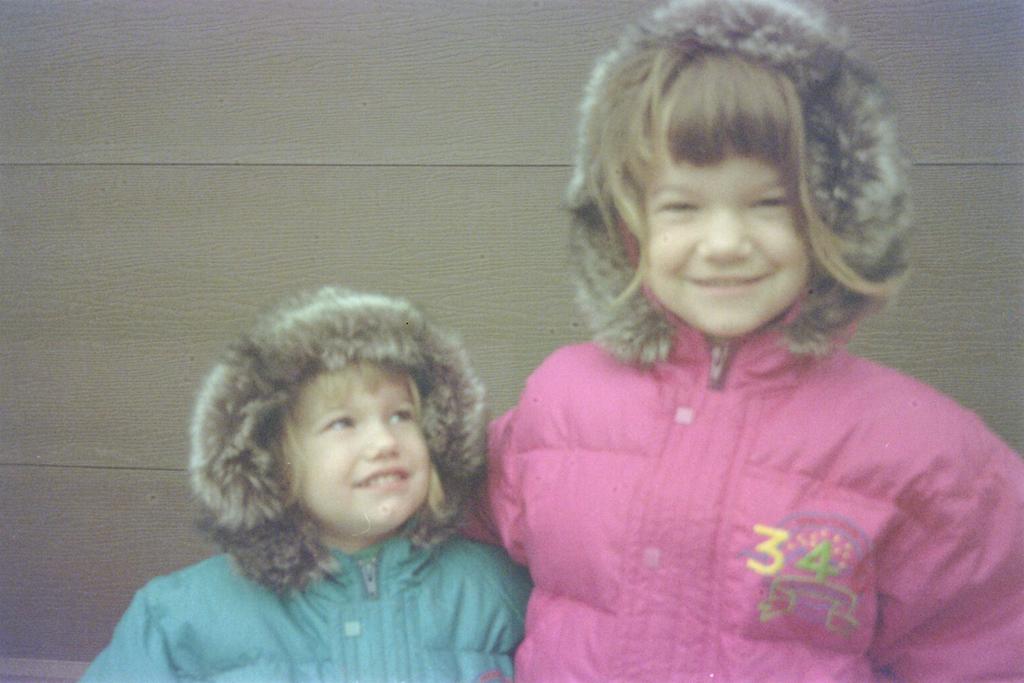
I am still developing rolls of film that have been sitting around. This one is at least 15 years old.

This was our first summer in Michigan, after we moved here from Hawaii. Richard is reading to Shelagh and Liz, except we called her Lizzy back then.


Here they are on the front sidewalk of my folks' condo in Leland. Now Liz is taller than Shelagh, but she used to definitely be the younger sister.


Liz was often mad at me because (she thought) I had decided to let Shelagh be born first. She so wanted to be the bigger sister. I would find Liz walking around muttering under her breath: "I hate my sister. I hate my sister..." I worried that those words would become her mantra, so I used to grab her and hold her and rock her and say "Your momma loves you dearly and she always will. Your momma loves you dearly and she always will....", trying to give her a new mantra.

Now Shelagh and Liz are very close, getting on each others' nerves only occasionally.

Reading the news over the last few days, I have found out that I raised those two all wrong. I knew at the time that they were born too close together (19 months) so they were doomed to suffer from crippling sibling rivalry. When I went in for prenatal visits with Liz, the doctors and nurses told me every visit that 3 years between children was optimal, and asked me if I had ever heard about birth control.

I never bought them pacifiers (just one more thing to lose) and they often slept in our bed with us, usually with a head nestled under Dad's armpit for warmth. Now it turns out that sleeping with your parents is dangerous, and not buying a pacifier for your baby promotes SIDS. I'm unconvinced. It seems like pacifiers are always falling on the ground (or worse), getting lost, and just generally getting a lot more attention than they deserve.

But wait! There's More! I was supposed to have those kids toilet trained before they could walk!. It's an interesting idea, right up until they quote the mom who calls early toilet training "a gift in our relationship." I can't quite figure out what that means, but it sounds like something you would say if you were trying to present yourself (subtly, of course) as the best mother in the room.

I can't remember how or when any of my kids were toilet trained. (I vaguely remember when they learned to read, but even that was not a race. What makes a good life is not whether you could read when you were five, but wheteher you still love to read when you're 40.) I remember ignoring all kinds of unsolicited advice when my kids were young. I fear if I was raising babies now, I wouldn't be nearly as polite.

Monday, October 03, 2005

Farmers: The Last Grown Ups?

This is from Robert Plamondon's Poultry Newsletter. (I don't think he's related to the Plamondons of Lake Leelanau, but he could be. He's from Oregon.)


The Last Grown Ups

The aftermath of Hurricane Katrina brought home to me the degree to which farmers are treated differently from other people.

You see it every day. Farming is dangerous, but you don't need a license. Everyone assumes that you can make your own decisions. I can go down to the feed store and buy hypodermic needles and an eight-ounce bottle of pennicillin anytime. At the pharmacy, I'd be considered to be a mere citizen and likely to hurt myself, so I'd need a note from a grown-up (in the form of a doctor's prescription).

A few years ago, when the Tillamook River flooded any number of dairy farms, the news was mostly about the risk to livestock, not to farmers. Afterwards, no one warned the farmers to stay away because they might come into contact with feces or agricultural chemicals!

The assumption was, "They're farmers. They can cope." No matter what the devastation, the reporters were confident that the farmers would roll up their sleeves and rebuild. The concern was all over the dairy cattle who were cut off from rescue by the floodwaters.

Of course, no sane person would assume differently with New Orleans. The mouth of the Mississippi River is one of the most important commercial locations in the world, with the entire produce of the American Midwest needing to be taken off barges and put on ships. Having a city at the mouth of the Mississipp is not optional! And there are plenty of determined people in New Orleans; farmers have no monopoly on toughness. Far from it! Yet with Katrina, the news always seemed to assume that the people in New Orleans were helpless and stupid, and needed to be kept from their own homes until everything was made nice and safe by the grown-ups from the government.

(No doubt a lot of this was fake; just bad reporting by city-slicker journalists and knee-jerk answers of "We're a lot more comfortable if we drag things out forever" from government officials who were not, in fact, in charge.)

I was surprised (but pleased) that the mayor of New Orleans reopened the city. He, at least, recognized that there's a difference between an evacuee and a prisoner, and that the citizens would mutiny and reopen the city on their if he didn't get a move on.

It's not that New Orleans is necessarily safe right now, it's just that grown-ups are allowed to take risks if they want to, and it's nobody's business but theirs. A lot of people seem to have forgotten this.

You get a lot less of this nonsense on the farm, but since our legislators are mostly city slickers, it's creeping up on us. It's been a long time since you could buy dynamite through the mail from Sears!