
Sunday, April 09, 2006

A Cockfight in the Philippines

A fellow casino dealer recently traveled to the Philippines and sent me the following account of a cockfight that he attended. No, he didn't set out to go to a cockfight, his in-laws took him there. But once there, he took part in the wagering and observed with a casino dealer's eye for the money.

Why post a story about a cockfight? I'm curious about the many ways that humans and chickens have evolved together, there's one reason. I'm continually frustrated by the public dialogue about avian flu, and the assumption that the normal way to keep chickens is in large egg or meat factories. The world needs to know more about what people do with chickens, even cockfights. Cockfighting is legal and popular in the Philippines. It is even televised, with its own commercials for cockfighting supplies. Yet, the Philippines is among the few nations in that part of the world that is still free of avian flu. Go figure.

There are some four-letter words in this, and violence, of course, so if you don't want to read it don't, but here it is:


After taking a PAL flight from Manila to Roxas City, I was treated to a three hour boat ride, on my brother-in-lawÂ’s boat, to the far away island of Jintotulo. Please keep in mind this boat had four adult passengers, two teenagers, a small child and a crew of four.


"A three hour cruise, a three hour cruise."

The tiny ship was rocked and I arrived there looking like a drowned rat and feeling like a Viking. When I got to Jintotulu (where my wife is from and her parents live) I got to go to a cockfight!

This was the highlight of my trip and a very JamesBondian experience.


Note the bleachers around the pit.

The locals move out of my way in order to give me a prime space to watch. There were no women or girls present. Everyone then starts to shout to the ringmaster in the center of the ring. Obviously they were making bets on either the white cock or the red one. I wasn't going to bet on the first match but after a couple of minutes the ringmaster looks at me and says; Hey Joe, you want to bet three hundred? I said; Yes, three hundred on the red one (pointing to the cock on my side of the ring). He waved his hand and with a smug expression indicated I had no bet. He then looked at me and waved his hand towards the opposite side of the ring. I then realized that since us bettors weren't laying odds or giving up points, he was trying to even up the betting at my expense. A minute later he asked me if I want to bet 500. I said yes and again pointed to the red bird. He waved off my bet and then grabbed himself in a Michael Jackson fashion, as if to dare me to bet on the white cock. Meanwhile the referee is writing down the bets in a spiral ring notebook.

The other man in the pit (the referee) then held a bird in each hand, faced them towards each other and released them. My bird scored the "dim mak" the other bird didn't die but was obviously unable to continue. This however, being a "fight to the death" the referee would grab a bird in each hand and face them off again. This process was repeated until the white cock was deemed to be dead.

Now all eyes are on "Joe" because he picked the winning cock, even though I hadn't won anything. At this point one of my nephews-in-law brings me a glass of "halo halo" which is a delicious Filipino desert made with shaved ice, jellied fruit and sweet cream. He explains that I'm sitting on the side of the ring for the first time birds. The experienced birds are brought to the other side of the ring. My oldest brother-in-law then tells me to "go look at the birds" and points to an area near a very old tree that is about 20 feet from the ring, where all the bettors are gathered.

This gathering is the equivalent of the "cock weigh-in" and there are six bird owners holding their prized cocks (birds). They hold the birds while facing them to each other in order to determine the two birds that display the most animosity towards each other. There is a lot of talking going on and I can tell the organizers are getting a feel for whether the betting will be equal in a match between the birds in question. I look at the old tree and I see how they disposed of the losing white cock: by dumping him unceremoniously at the roots of the "tree of woe."

After the contestants are selected, the owners begin the process of tying and taping the three inch long curved blades to the left ankle of their bird. In some cases these blades are selected from a collection displayed in a wooden case that was probably more accustomed to containing expensive silverware in its previous life. After the cocks are ready everyone returns to the ring and the shouting starts immediately. The cocky (pun intended) ringmaster looks at me and asks if I want to bet 500 Filipino money (10 USD). I said yes and pointed again to the red cock. He seems to book my bet and I look to my brother-in-law and ask him if I have a bet. He says that he doesn't know because he doesn't bet on cockfights. I said I just wanted to know if I have a bet or not and he finally says he thinks I do.

The referee released the birds and my bird jumps high and seems to drive its blade in the chest of his opponent. Everyone (including the chickens) knows that the white cock is doomed. The referee continues to pick up both birds and face them off, even though the white bird merely hangs there limply. After he releases the birds, my bird merely pecks at the face and eyes of his adversary. He is taking no chances of getting close to the other bird's feet, where a voluntary or involuntary kick could send him to the tree of woe.

Now please don't think harshly of me because at this point and I stand up and scream; "FINISH HIM!" which brought cheers from my brethren of those that bet on the red cock. The white cock was finally declared dead (it looks strange seeing the referee check the bird's wrist for a pulse) and I stand up again to join my comrades in a barbaric roar.

The organizers then collect the losing bets, which are generally crumpled and thrown angrily to the center of the pit. I ask my brother-in-law if I should ask for my money and he tells me not to worry. The referee then comes to me and hands me a 500-peso bill. I smile, thank him and display my coin purse as I gingerly shove the bill into it. I announce; "It was a pleasure doing business with you." This brings roars of approval from everyone in the pit area.

The third bout was a replay of the first: cocky ringmaster won't book my bet and my bird ends up winning.

Now "the legend of Joe" is truly born and I strut to the weigh-in like I'm Nick the Greek. I have my eye on one red cock that will face another red cock. The owners tape the blade one of the birds with blue tape so us bettors can tell them apart. The ringmaster then announces; "In this corner with the blue trunks (OK, tape) is a SIX time championnnnn!!!!" He then immediately looks at me and asks if I want to bet five hundred. I was not naive enough to believe that this bird was a six-time champion but that cock was scratching the ground with his claws (which I took to be a sign of aggression) while his opponent merely stood in the ring, looking around like he was thinking; "Where am I? What am I doing here? And why is everyone looking at me?" I immediately agree to bet 500 on the blue trunks when here comes a clear signal that "Joe the Greek" is about to get fleeced. Another cock trainer comes to the ring carrying a bird. He shoves it is the face of my bird's opponent in order to get him riled. I knew I was f**ked but also knew that the worst thing that could happen is that I would break even for the day on the last bout. And besides, no one was beefing, so I can assume that this is within the Queensbury rules of cockfighting.
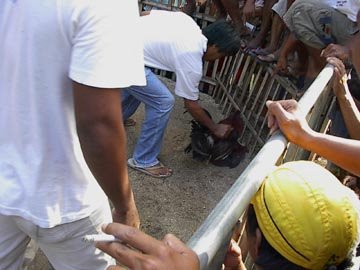
This is a picture of me losing my money.

To no ones surprise, I lost my bet but managed to take what was to be the last photo on this set of batteries. I choose to be a gentleman and hand my money to the referee and say; "Easy come, easy go." Which the crowd seemed to appreciate. I then retired to the "store" across the street where I drank warm San Miguel beer (to excess) with my brother-in-law and one of my wife's uncles, who was a lawyer and had a pleasant conversation about dealers cheating the players and witchcraft on the island. There were two other tables with people playing mah jong and "tong 8" which is a cross between rummy 500 and tonk.

Now please don't misunderstand: I have a total distain for the "sport" of dog fighting but after all these are chickens we are talking about. After much useless searching, I finally scored a cockfighting tee shirt at the gift shop of the Heritage, which was the first Hotel I stayed at (typical). I plan on wearing it to the first PETA rally I can find.

Dale S. Yeazel

There is so much going on in the world of backyard poultry. I liked that quote in the New York Times last week about how long distance shipping of day-old chicks "has made the chicken the most migratory bird in the world". Another report from the New York Daily News described a international cockfighting derby in Manilla last January that attracted entries from around the world.

When I lived in Honolulu, all of my neighbors had chickens but nobody ever had eggs for sale. Cockfighting is as old as the hills; I've never been able to keep roosters from trying to kill each other, unless they develop their own survival strategies. I'm guessing that the knives speed the contests up, facilitating the betting action, and saving the work of slaughtering the loser. I can't find the link, but I read a story a few years ago about a guy in the Phillipines who failed to restrain his rooster after getting it all hyped up to fight. He was slashed in the groin by his own bird and bled to death. ("Joe the Greek" tells me that he saw the handlers put leather sheaths over the blades until it was time to fight.)

In the avian flu news there is a disconnect between the science and news reporting world, and the backyard chicken world. Chickens are more than just meat and eggs -- here they are providing entertainment and a shot at fame and fortune for a few skilled (and lucky) backyard breeders.

Tuesday, April 04, 2006

The Magic School Bus

I'm adding a new blog to my list. The Magic School Bus is about science education, written by Bora Zivkovic, who teaches biology lab to college students in Chapel Hill, North Carolina. I particularly liked this account of using the process of putting together a jigsaw puzzle to illustrate the scientific method:
So, what are you doing first? Looking at the pieces - that is observation. You still have absolutely no idea what the Big Picture is going to be, but you are looking for a good starting point, so you are soaking in all the information that you can glean from all the jumbled pieces on the table. So you are taking prior knowledge and using it to make sense of observed phenomena.

What are you doing next? You are trying to put some pieces together. Those are experiments. Every time you pick up two pieces and try to put them together you are testing a hypothesis - that the two pieces will fit. Most of the time your experiment fails at the first try, so you try again by rotating the pieces a little bit at a time and trying again. If it does not work, you drop the pieces and leave them for later, as obviously you need additional information. If it works, you publish your findings in a scientific journal and move on to the next hypothesis.

I see that different people have different approaches. Some look for edge pieces and try to put them together. Others are looking for any two pieces that may have shape, color and pattern similar enough that they may fit together, yet others are looking for key pieces - those with most interesting pieces of information, like an eye or a nose.This is just like personal styles of different scientists. Some start with easily gleaned information - the edges - and systematically build on it, piece by piece. They know that this approach is slow and tedious, but will certainly, over time, build the whole picture. Others do something more risky - go for the most interesting information although it is difficult to study it or to place it in a broader context. They are more likely to fail, but if they get it right, the returns on the investment are enormous - they have figured out what the big picture is going to be without doing all the detailed boring work............... Read more here.

Go ahead and read the whole piece, especially if you don't think of yourself as a scientist. Or maybe I should say "especially if you're a journalist." Journalism and science see to be butting heads a lot lately, on everything from cholesterol advice to bird flu to climate change. Journalists want the whole story now. Scientists know the story isn't whole, yet, and they reserve the right to revise the story as new data comes in. Just like working a puzzle.

Friday, March 31, 2006

Avian Flu and Intellectual Property

Illustration of a Pheonix breed rooster and hen
Data hoarding continues to impede avian flu research. While many samples of the virus have been collected and genetically sequenced, the researchers, labs and nations involved have been reluctant to make this information public.

Everyone hopes to be the first to win fame and fortune as the developer of the first avian flu vaccine, the patent-holder on the next flu drug, or even the genetic engineers of the flu-resistant chicken.

The chicken engineers are thinking big. Just look at this quote from the UK Times:

Even if the technique works, it will be several years before it can be used to stock farms and it also faces important regulatory hurdles and a battle to win over public opinion. If these obstacles are overcome and farmers are willing to adopt GM chickens, the entire world stock could be replaced fairly quickly.

Once we have regulatory approval, we believe it will only take between four and five years to breed enough chickens to replace the entire world population, Professor Tiley said. Developing flu-resistant chickens has clear benefits for human health and animal welfare, as we wouldn't have to slaughter chickens around the world. Chickens provide a link between the wild bird population, where avian influenza thrives, and humans, where new pandemic strains can emerge. Removing that bridge will dramatically reduce the risk posed by avian viruses.


Wow. Replacing the world's mind-boggling diversity of chicken breeds with a few genetically-engineered breeds.

One of our favorite pastimes this time of year is catalog shopping for chicken breeds. We get the catalog from Murray McMurray Hatcheries and weigh the strengths and weaknesses of various breeds. Some are bred for egg laying, some are bred for meat, some are old fashioned "dual purpose" birds. Some are known for temperment, important if you have a small yard and close neighbors. Some have retained "broodiness", the instinct to set on eggs and raise chicks that has been discouraged in lines bred strictly for egg laying. There are fancy breeds, blue egg layers, Polish crested chickens, and feather footed cochins.

So many chickens! Some breeds are foragers, ready to go out in the world and scratch for their dinner. Some are bred to just hang around and pump out eggs. Some are smart enough to roost in the trees at night. Some have had the sense bred out of them; they just huddle on the ground and wait to be eaten.

Each breed is the result of generations of breeding. I suspect the smarter, thriftier birds are the result of breeding that spans human generations, not poultry generations. There are countless more varieties of chickens, a different variety living in each little corner of the world, bred for centuries to best suit the microclimate and needs of the people who live there.

This is the old-fashioned method of genetic engineering: selective breeding and cross breeding to secure the traits that are favored. In good times, you might breed for a fancy tail. In bad times you might breed for survival in famine or resistance to the latest disease.

Now, confident that the only answer is in gene splicing, we are depopulating the countysides of their locally-bred chickens, in a losing battle to contain the virus. The disease is devastating to flocks; the birds look fine one day and the next morning 80 to 90% are dead. One wonders if the clue to flu resistance in poultry lies in that small sliver of surviving birds, the ones that are being culled with the rest. Or maybe it lies with the flock next door that appeared untouched by the disease but was culled anyway.

The first images of avian flu showed us armloads of chickens, held upside down by their feet, on the way to incineration. As someone who has catalog shopped chicken breeds, I wanted to shout: "Wait! What kind of chicken is that? Show me again, right side up! What a cool bird!"

But it was gone. Not just from my TV screen, but probably from the face of the earth.

Some people's intellectual property lies in their lab. Some people's intellectual property scratches and clucks out in the yard. How odd that we allow lab-base intellectual property to be hoarded, to the detriment of mankind, while barnyard-based intellectual property is tossed on the burn-pile?

Thursday, March 30, 2006

Today's news is about the release of Jill Carroll, the journalist kidnapped in Iraq. She is safe, well, and emphasizing that she was well treated by her captives.

Back in January, right after the kidnapping, Riverbend posted a eulogy for Carroll's driver and interpreter, who was killed during the kidnapping.

Today I spent daytime hours at work, where the breakroom TV is usually on Fox or CNN. I'll be surprised if Alan is mentioned, unless Jill herself brings him up.

Wednesday, March 29, 2006

Lake Michigan Levels: In Permanent Decline?

A 2005 study suggests that lake levels in Lakes Michigan and Huron are in permanent decline. According to the January 24, 2005 press release
:“In 1962, a shipping channel was dredged out of the St. Clair River that effectively opened a bigger drain hole in the Great Lakes,” said John Pepperell, president of Georgian Bay Association, a Canadian non-profit organization which coordinated the six-month study by W.F. Baird & Associates Coastal Engineers for GBA Foundation, a registered Canadian research charity. “Everyone knew about the one-time loss of water that was caused when that channel was first opened. However, we have now discovered that ongoing erosion is making the outlet from Lake Huron larger, allowing water to leave faster than had been recognized.”

According to the report, the channel is eroding and is now over 60 feet deep at critical sections near the outflow. It only needs to be 30 feet deep for shipping. Pepperell said that “without implementation of corrective measures, this drop represents an irreversible and ongoing decline in the long-term average levels of Lakes Michigan and Huron.”


You can read the whole report here (PDF 141 pages), the press release here,and the Army Corps of Engineers' rebuttal here. From Leelanau, surrounded by Lake Michigan, it's hard to ignore what seems to be ever-widening beaches. Lake levels do come up after a hard rain, but they drop soon after. We have been several winters without good ice cover on Lake Michigan (ice prevents evaporation) and big snowfalls to melt and replentish the lakes.

Thursday, March 23, 2006

Liz

Posted by Picasa
I just downloaded Picasa 2 and I've been playing with it. This is an image of Liz that Shelagh took down by the lake. I was able to remove the shadows from Liz's face, convert her to black and white, and soften the focus on everything but her face.

She looks like she's flying.