Showing posts with label farming. Show all posts

Friday, August 07, 2009

4-H Livestock Auction

Two 4-H kids and their lambs, waiting for their turn to show.

The Northwest Michigan Fair opens on Sunday, with the culmination of the 4-H Livestock projects, the 4-H Livestock Auction, taking place on Thursday, August 13th. The 4-H Livestock Auction is an opportunity to purchase high quality, local, home grown animals for meat, for breeding stock, or to add to your laying flock. It is also the place to buy less mainstream meat like goat, rabbit or duck. For those who want to truly know what they are eating, the fair is an opportunity to interview the person who raised the animal, peruse feed records, compare animals, and to see who was deemed the best by expert livestock judges.

Darrel Robinson of the 4-H Livestock Council was kind enough to give me some advice about the action for first timers. 4-H kids will be showing their animals all week (see schedule here) through Wednesday, and will rated for both the quality of their animals and for showmanship (their knowledge of and handling of their animal). Wednesday evening , the eve of the auction, is a good time to walk the barns and talk with the kids about their animals. Registration for the auction is at 8 am on Thursday morning; the auction starts at 9 am. The auction proceeds one specie at a time, beginning with swine. The lineup looks something like this:
Swine
Turkeys
Ducks
Lambs
Goats
Steers
Meat Chickens
Production Chickens (layers)
Dairy Feeders
Rabbits
Jr. Beef
There is a free appreciation luncheon for all registered buyers at noon on auction day. Registered buyers also get free fair admission on auction day. Buyers are also publicly thanked in fair and newspaper advertising. If you are interested in bidding on an animal but can't be there for the auction, you may complete a "proxy card" which authorizes 4-H Livestock Council to bid on your behalf. Call 228-6562 to get a buyer's pass or a proxy card.

After the auction, you may choose from five different local processors, who will slaughter, butcher, vacuum pack, and freeze your meat to your specifications. The processors will have their services and prices posted at the auction. Smoking and other specialty processing is available. 4-H will transport your animal to the processor at the close of the fair. (If you wish to take your animals home instead of to a processor, this is allowed.)

Families who have purchased or shared in the purchase of a cow or pig tell me that having a whole animal in the freezer challenges them to find recipes for more than the usual cuts of meat. I've found these recipes in older cookbooks and ethnic cookbooks. Authentic ethnic cooking often requires goat, rabbit or duck, smaller animals perfect for adventuresome cooks with less freezer space.

Buying at the 4-H Livestock Auction is more than just an alternative way to buy food. Last week at the Traverse City Film Fest, I saw Food, Inc. and was inspired to hand out Livestock Auction brochures at the discussion afterward. During the film, the audience murmured and groaned during scenes of animal distress. I was more moved by descriptions of farmers' distress. The cheap meat that we see in the grocery store is made possible by a system that forces farmers to accept higher and higher levels of debt and diminishing levels of actual income. I'm not worried about the future of the factory far. -- the system is unsustainable and will crumble under its own weight -- but I'm worried that as we build more sustainable systems we will face a dearth of young people who know how to actually work with animals. Supporting 4-H through the Livestock Auction is a way to support the next generation of food producers.

Wednesday, February 04, 2009

Our Hoop Housing Neighbors on NPR

Mature greens in Jon and Jenny's hoop house, mid April of 2005. I think this was the first year they ran the hoop house.

I never look at this picture without wishing for an excuse to post it to the blog again. Tonight I got my wish. As I hopped into the car and headed off to the planning commission meeting, I heard a familiar voice on NPR. Jon Watts and Jenny Tutlis of Meadowlark Farm, just up the road, were featured in a piece on season-extending farming in the frozen North. For years Jon and Jenny have been our faithful neighbors, the ones who trade chicken chores so we can leave town now and then, the parents of Anna's friend Ella, and Liz's much loved employers last and next summer.

You can hear the whole interview or read the transcript by clicking here.

Posted by Picasa

Saturday, November 08, 2008

Tandem Ciders

Cider maker Dan Young serves a packed house on Saturday afternoon.

Even with gas down to 2.15 per gallon, I know that getting in the car to run just one errand is a waste of my carbon footprint. Still, I needed to go over to the casino to pick up my paycheck, so on the way back I decided to check out the Tandem Ciders sign that has be recently erected on M-22 at Setterbo Road.

I had a idea of what was up there thanks to an article in this week's Leelanau Enterprise, but hard cider has always been something that happened by accident, something that figured in Grandpa Gord's stories of growing up in the UP, or in the case of a friend's old-school grandmother, something that teetotalers drank because it wasn't really alcohol. So it was funny, at least to me, to find that I had inadvertently joined a throng of wine-tasters working their way from one winery to the next. The small tasting room was packed, proprietor Dan Young was swamped, and I ended up talking to a lady who was not quite sure where she had ended up.

"So what is this hard cider?" she asked me, looking at her the contents of her sample glass, a clear, dry, golden cider made from old-fashioned Northern Spy apples. Northern Spys, an heirloom variety from the 19th century, were Grandpa Gord's favorite apple, the same apples that I sought out for him every fall in the last years of his life.

"It's wine made from apples."

"You can make wine from apples?"

"Sure. You know the sweet cider that we drink in the fall? That's unfiltered apple juice. If you ferment it, you get hard cider."

Just as the sweet ciders can vary greatly in taste depending on the apples used, the three hard ciders I tasted each had their own character. The Northern Spy was dry and sophisticated, nice, but a little formal for just knocking around on this beautiful fall day. The Farmhouse blend used the varieties that were the mainstays of the apple industry 30 years ago -- Macintosh, Romes, (did he mention Empires?) a little Delicious -- for a sweeter taste that seemed a little thin, at least when it followed the Northern Spy.

I liked the Bees Dream, a blend made with a different yeast. This one was just nice, a full, friendly hard cider. All three ciders that I tasted were 2007 apples. The folks on the other side of me were drinking this year's Macintosh, which was being served on tap, but the barrel ran out before I could try it. Being new, it was still a tad cloudy and the folks enjoying it, friends of the proprietor, praised it as the best cider there.

I bought a bottle of Bee's Dream, for $10. They were also selling gallons of fresh cider, one of the few places where you can still buy fresh cider so late in the season.

Tandem Ciders is located on Setterbo Road, across from the Toy House. It is the white barn with the bicycle-built-for-two above the door. When you go there, check out the dark-sky-friendly light fixtures above the doors.

Tandem Ciders is open Wed-Sat from 11 a.m - 7 p.m. and Sun from Noon to 5 p.m.


Posted by Picasa

Thursday, September 18, 2008

The Future of Livestock

I've been revisiting livestock issues in preparation for an invitation to speak at next week's American Livestock Breed Conservancy conference in Kalamazoo.

I first became aware of the livestock breed conservancy back in 2005 when I was writing about avian flu, and watching TV footage of culled flocks in Hong Kong headed for the incinerator.
Keeping chickens is a sort of window to the wider world. The everyday chores of caring for poultry is something that humans have been doing in similar fashion for most of recorded time. It is also something that is done, with little variation, almost everywhere that people live.

It was hard to stop thinking about those first bird flu reports from Asia. I saw fleeting images of beautiful birds on the evening news as they told of killing all poultry in whole provinces. At first I wondered how many interesting breeds of chickens were going extinct.
Later, I became worried that we were destroying the generations of intellectual property, and the secret to the avian flu problem, in this wholesale culling effort:
Each breed is the result of generations of breeding. I suspect the smarter, thriftier birds are the result of breeding that spans human generations, not poultry generations. There are countless more varieties of chickens, a different variety living in each little corner of the world, bred for centuries to best suit the microclimate and needs of the people who live there.

This is the old-fashioned method of genetic engineering: selective breeding and cross breeding to secure the traits that are favored. In good times, you might breed for a fancy tail. In bad times you might breed for survival in famine or resistance to the latest disease.

Now, confident that the only answer is in gene splicing, we are depopulating the country sides of their locally-bred chickens, in a losing battle to contain the virus. The disease is devastating to flocks; the birds look fine one day and the next morning 80 to 90% are dead. One wonders if the clue to flu resistance in poultry lies in that small sliver of surviving birds, the ones that are being culled with the rest. Or maybe it lies with the flock next door that appeared untouched by the disease but was culled anyway.

The first images of avian flu showed us armloads of chickens, held upside down by their feet, on the way to incineration. As someone who has catalog shopped chicken breeds, I wanted to shout: "Wait! What kind of chicken is that? Show me again, right side up! What a cool bird!"


Just those few short years ago, it seemed that, except for a few of us hobby farmers and the tiny boutique foods market, the trend would continue towards out-of-sight, out-of mind, larger and larger factory farming operations. All cows looked alike because they all were alike; in 1997 it was estimated that 60% of our dairy cows came from the same four breeding lines. Every commercial specie of livestock had been bred to be the most efficient at turning cheap corn into edible protein. Traits like ability to forage, curiosity, even the common sense to get out of the rain took a backseat to feed conversion or disappeared altogether.

That was then. These days, avian flu takes a back seat to bigger problems. Cheap corn is no longer cheap -- beyond the lunacy of trying to run automobiles on corn-based ethanol, there is a new awareness that corn yields depend on large doses of nitrogen fertilizer and that nitrogen fertilizer is made from ever more pricey natural gas. Feedlots are implicated in the rise of new, deadly E.coli strains. Climate change, and the need to reduce greenhouse gas emissions and sequester CO2 is front and center, and we are looking at the role of pastures and grasslands in global carbon sequestration. In the US, our current food production is dependent on the rapidly depleting aquifers of the western states; we use our expensive fossil fuels to move food long distances to the food producing areas of the 1900's which are now covered with homes on one or two acre lots where the fertile soils and abundant rains now grow shrubs and lawns.

I'm intrigued by a comment that I read in a discussion of home food production. A person familiar with the history of her suburb noted that the original lot size was meant to provide a family with the land they would need to raise most of their own food in gardens, orchards, and with some small livestock. Last summer we saw many families return to gardening in response to higher food and fuel prices. If trends continue, we may see many more backyard poultry flocks, rabbits, or even milking goats.

If you see suburban poultry, goats, or even pigs these days, chances are it's a 4-H project. 4-H has fostered the relationship between kids and livestock for all of its 100 year history, even as the bulk of us have moved away from the traditional farms. Rabbit and poultry projects are ever popular for small yards, and there are new projects like Horseless Horse, Small Pets and Goldfish for kids with no yards at all.

The traditional large animal projects prosper around here. Northwest Michigan Fair's livestock auction signed up 125 new buyers this year, not surprising considering the renewed interest in eating local, and knowing what you are eating. Where else can a person choose meat for the table by perusing growth, feed, exercise and medical records of each animal and interviewing the person who raised it?

Kids learn responsibility, business skills, grace under pressure, time management, teamwork, and a host of other skills from working with livestock. 4-H folks have been extolling these character building themes for years as the rest of the world asks why we want to keep doing something as old-fashioned as raising livestock in our backyards.

Lately I've been rethinking the purpose of making sure that kids get experience raining livestock. When I think of the challenges facing us, I want to everyone -- our leaders, our families, our communities, our kids -- to have as all available tools. When policymakers are working to reduce greenhouse gas emissions while ensuring our food supply, they need to know a lot about cows, not just that they produce methane. Community planners need to recognize that backyard food production is part of the health of a community and not just reflexively zone out livestock because they want to head off potential factory farms. If times get really tough, we could send our 4-H livestock kids, leaders and alumni out to the suburbs to teach people how to feed themselves from that good farmland under those lawns.

Tuesday, August 05, 2008

At the Northwest Michigan Fair

This is Clucky, a silky hen who was displayed at the fair by Krystal Bancroft of Thompsonville. This year's poultry barn featured several young ladies who were enthusiastic about talking birdcraft to visitors. Clucky has raised a few broods, and one of her offspring was on display as well.

We watched the lamb showmanship competition. These girls were waiting for their turn in the ring.

Showmanship is the way you work with your animal. The kids were in the ring for 20 minutes with no halter or leash, just controlling their animals with their hands and bodies. Competitors need to know how to handle their animal, presenting it for the judge and the audience so that everyone gets to see the animal in the best light. You could be a good handler but still have trouble in this competition if you haven't taken the time to work with your animal and make it comfortable and used to being handled.

Nani and her dad showed up while we were watching the showmanship competition. Richard decided that there should be a similar competition for parents and their kids, where you have to enter the ring with your kids without resorting to bribes or electronic devices. Nani's dad, a horse trainer by trade, thought that was a great idea and the two dads had a good laugh over the idea.

I had resigned myself to a corn dog lunch when I saw this table of local produce from Cherry Capital Foods. For the price of a corn dog, I got a pint of nearly perfect raspberries. Cherry Capital Foods is a new distributor of local produce and farm goods. Maybe that's where I'll sell my rhubarb next year. Taste the Local Difference was co sponsoring the booth. Fair food is what you make it!

Posted by Picasa
Fair is about food, where it comes from and who grows it. This goat poster made me laugh with its "look your dinner in the eye" theme.

Tuesday, February 12, 2008

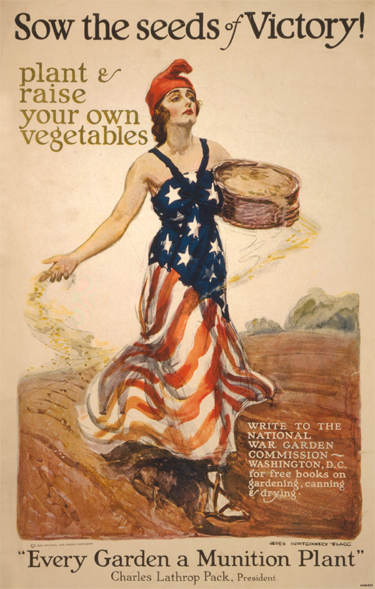
Victory Gardens


A World War II era Victory Garden poster. (Oops, I mean WW I)


I've been on a list binge for a while and I planned on writing a list of reasons for planning a garden this year, even if you didn't last year. Sharon, over at Depletion-Abundance, beat me to it, with a nice post listing many reasons for growing a garden. I'm long overdue on posting pictures, so I found another version of her Victory Garden poster, and will add my own thoughts on gardens.

I read Michael Pollan's The Omnivore's Dilemma this winter. Having spent a lifetime thinking about food and where it comes from, I didn't expect any big mind-blowing revelations in this book, but I got some anyway. In the first third of the book, Pollan examines the energy origins of the fast food meal, and in the process ends up talking about a good deal of the food we find on the grocery shelf. Most of the components of processed food are derived from corn, corn is dependent on nitrogen fertilizer, and nitrogen fertilizer is manufactured from natural gas. When you look at the fuel used to plow, plant, spray, harvest, dry, transport, and further process corn and it's derivatives, you start to think of eating corn as tantamount to eating oil.

Synthetic nitrogen became plentiful at the end of WW I as nitrogen was no longer needed for the production of explosives. Our current system of industrial agriculture arose as a way to use this new abundance of nitrogen. Without synthetic nitrogen we would be soon be searching for alternate sources of calories. The caption on the poster, "Every Garden a Munitions Plant", was originally meant as a metaphor, but we might think a moment about our food security in an age when America is dependent on foreign fossil fuels to put food on the table.

So that's my new reason to grow a garden. In my last post, I listed four reasons to save energy. Now I'm presenting gardening, even just a little gardening, as a way to save energy and ensure our food security--as if eating well wasn't it's own reward!

Correction, although I found the Victory Garden poster on a website devoted to WW II, it clearly dates back to WW I

Monday, January 29, 2007

What's for Dinner?

The Lansing State Journal reports today that Michigan's entire corn crop could soon be consumed by ethanol factories.

I wonder what we're going to eat? The price of chicken food (layer mash) was $7.50 last summer. Now, thanks to the futures market, that same bag costs $11. We can expect egg, milk, and meat prices to rise with the cost of feed.

The price of corn is a big issue already in Mexico, where the price of tortillas has more than doubled in the last year. In Africa, cornmeal is a staple, the main dish that each meal is built around. Here, corn is cheap, even at double the price. This week in the Leelanau Enterprise there was an ad for "Furnace Corn". Yes, with all these trees around here, some people are burning corn cobs to heat their homes.

Things will change if the ethanol boom holds up. I can't figure out why ethanol is all the rage but conservation is never mentioned.

But don't worry. Gas will be cheap, as we drive all around town looking for affordable groceries.

Wednesday, December 13, 2006

Microchips on the Farm

I've been watching the growing controversy about the microchip tracking of farm animals for about six months. This week it made national news in a NYTimes article:
A federal effort to quickly pinpoint and contain outbreaks of disease among livestock is coming under attack on farms, in Internet chat rooms and at livestock markets, ranches and feed shops across the nation.

Although the effort, the National Animal Identification System, intended to trace a sick animal to the property it came from within 48 hours, is still in early, voluntary stages, the United States Department of Agriculture has had to retreat from a proposal to make it mandatory. Officials now say that further participation will result from financial incentives and market pressure.
I'm glad that the feds are backing off the program, which I suspect was propelled in part by microchip manufacturers looking for new markets. (There has also been a similar push to implant US servicemen with microchips). Once again, we see policy makers who have very little knowledge of the various ways in which people interact with animals.

When I get day-old chicks, they cost about $1.25 each, shipped in the US Mail in lots of 25. They are remarkably hardy, but I still expect to lose two or three in those first few days. (We have to carefully remove them from the shipping box one at a time and dip each one's beak in the water to teach them how to drink, else they'll die of thirst.) According to the proposed policy, I would pay an additional three dollars per chick to buy them each a microchip, plus whatever it cost to get the microchip implanted. When a bird died, I would have to report the death and somehow scan the microchip. When we took birds to the fair, or sold them, it would require a permit. When I have a broody hen who raised her own chicks I would have to get them implanted, if I could find out where she was hiding them.

I suspect that more regulations, imposed by a federal bureaucracy that can't afford to do the job right, will burden the good farmers and be flaunted by the few who don't give a hoot. Why bother to keep your fences mended if all of your cows can be located by GPS when they stray?

Profit margins in agriculture are not that great, and it's not clear that small farms will be able to absorb the new costs of this program. The microchip program is being promoted as a remedy for concerns like avian flu and mad cow disease, that are arguably the result of the globalization of our food chain. We need small local farms now more than ever.

Monday, October 23, 2006

How Grandma Mimi became a 4-H Leader

When my girls were little I would often coerce them into sticking with an onerous task by telling them stories about their ancestors. Lately I've been thinking about my Grandma Mimi, and how she became a 4-H leader.

Mimi was not the sort of person who you would expect to volunteer for anything, let alone 4-H. She grew up in town, by her own admission a willful, spoiled child. Those of you who knew me ten years ago may remember me muttering about my willful, spoiled grandmother. At age 97 she still dressed to the nines every day and demanded that I take her to lunch and shopping at least once a week. She was a modern woman of the flapper era. As a teenager, she would sneak out to jazz clubs. As a young woman, she bobbed her hair, attended teacher's college and expected to make her own way in the world. Recently a family friend showed me a picture of her mom and my grandma in their twenties. They were dressed as sailors in order to sneak in to a Detroit burlesque show!

But times change and we have to change with them. By the 1930's, Mimi was a mom and a teacher, teaching at Warner School in Flushing. She was appalled to realize that the girls at her school were coming to school without underwear. During the Depression, even a few pairs of underwear were a luxury that few could afford. This is where 4-H comes into the story. Mimi went to the 4-H office and learned how to teach sewing. She taught her students how to sew their own underwear, from flour sacks.

Later she teamed up with Extension again, to set up a hot lunch program in her school. My mom tells of Mimi canvassing the county, accompanied by her friend from the sailor suit episode, convincing farmers to donate food so that kids could be assured of at least one good meal a day.

This is the image I come back to when I try to tell people why it so important to save Leelanau County's 4-H program. Other organizations have work with kids. Other organizations may include kids in their agendas. 4-H is the only organization dedicated to asking and answering the question "What do these real kids need, right now?" Times change, sometimes way too quickly, but childhood is short and kids' needs are immediate.

The time until the election is short, also, and 4-H needs your help. I know most of us volunteer for 4-H to work with kids, not because we like fundraising or campaigning. But, like Mimi, we are asked to reinvent ourselves to answer new challenges. Lets all challenge ourselves a little this week and ensure the future of Extension and 4-H.

Friday, October 07, 2005

Really old photos

I am still developing rolls of film that have been sitting around. This one is at least 15 years old.

This was our first summer in Michigan, after we moved here from Hawaii. Richard is reading to Shelagh and Liz, except we called her Lizzy back then.


Here they are on the front sidewalk of my folks' condo in Leland. Now Liz is taller than Shelagh, but she used to definitely be the younger sister.


Liz was often mad at me because (she thought) I had decided to let Shelagh be born first. She so wanted to be the bigger sister. I would find Liz walking around muttering under her breath: "I hate my sister. I hate my sister..." I worried that those words would become her mantra, so I used to grab her and hold her and rock her and say "Your momma loves you dearly and she always will. Your momma loves you dearly and she always will....", trying to give her a new mantra.

Now Shelagh and Liz are very close, getting on each others' nerves only occasionally.

Reading the news over the last few days, I have found out that I raised those two all wrong. I knew at the time that they were born too close together (19 months) so they were doomed to suffer from crippling sibling rivalry. When I went in for prenatal visits with Liz, the doctors and nurses told me every visit that 3 years between children was optimal, and asked me if I had ever heard about birth control.

I never bought them pacifiers (just one more thing to lose) and they often slept in our bed with us, usually with a head nestled under Dad's armpit for warmth. Now it turns out that sleeping with your parents is dangerous, and not buying a pacifier for your baby promotes SIDS. I'm unconvinced. It seems like pacifiers are always falling on the ground (or worse), getting lost, and just generally getting a lot more attention than they deserve.

But wait! There's More! I was supposed to have those kids toilet trained before they could walk!. It's an interesting idea, right up until they quote the mom who calls early toilet training "a gift in our relationship." I can't quite figure out what that means, but it sounds like something you would say if you were trying to present yourself (subtly, of course) as the best mother in the room.

I can't remember how or when any of my kids were toilet trained. (I vaguely remember when they learned to read, but even that was not a race. What makes a good life is not whether you could read when you were five, but wheteher you still love to read when you're 40.) I remember ignoring all kinds of unsolicited advice when my kids were young. I fear if I was raising babies now, I wouldn't be nearly as polite.

Friday, April 08, 2005

50th Wedding Aniversary

Last week we traveled to Lockport, New York for my parents' 50th wedding anniversary.


Pete and Jane Wendel on their 50th Wedding Anniversary.

I hadn't anticipated the potential for amusement in this turnabout scenario. We went back to our hometown, invited all of our parents' friends to a party, and then told their friends stories about our parents, instead of the parents talking about us.

My mom's friends thought it was great fun to come up one by one and ask "Do you know who I am?" It has been probably 20 years since I saw a lot of the folks who were always around when I was growing up so I was usually stumped, but sometimes I could get a glimpse of the sparkle in an eye that brought to mind the son I had gone to school with. Sometimes the lilt of a voice was still unchanged. There was no logic, just a quick intuitive search through memories that I don't think I've accessed in decades.

Memory is an odd thing. My siblings and I remember different things about our childhood. Some things we all remember, but we remember them differently. I think that's why photos hold such appeal; they seem like placeholders in our memories, reference points that everyone should be able to agree on.

We expected to leave for home on Sunday afternoon, but six inches of wet April snow forced us to stay another night and then leave at 3 am when it was already melting. On that last night I sat with my mom and Aunt Lynn looking at photos from my great-grandparents' time. Some of the people were identified, some we could figure out, but many questions remained. I found myself studying the faces of people who looked familiar, but who I had never met. I wonder what they were like, what they thought about, if they were happy. I don't know what I expected to find; photos taken five minutes ago often seem to not match our moods and characters. Still, I looked.

So the photo above is underexposed and has lousy color. But it shows the mood of the day loud and clear. A good time was had by all.