Showing posts with label local food. Show all posts

Monday, November 30, 2009

Thanksgiving

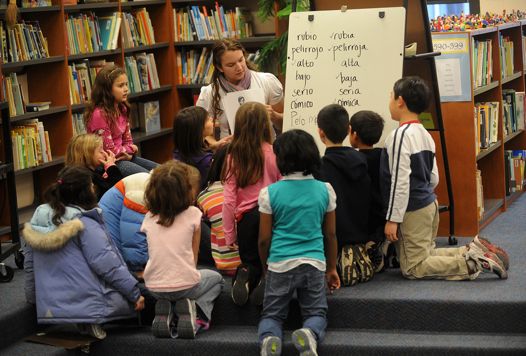
University of Michigan senior Shelagh Fehrenbach works with a group of third graders on Spanish words during a class at Ann Arbor's King Elementary School. Melanie Maxwell | AnnArbor.com

It was a treat to have daughter Shelagh and her husband Jordan home for a short Thanksgiving holiday. My favorite moment was when Shelagh was reacquainting herself with the piano and Beethoven's "Sonata Pathetique" in all its head=banging glory while Jordan and I swept up the kitchen and Anna hovered over Shelagh's shoulder, turning pages and watching music and hands.

We ate a smoked turkey from Carlson's and lots of side dishes. Shelagh and I sort of tag teamed teaching Anna how to make the pies. We burned the first baked pie shell so we had two lemon meringue pies and no apple, but apple is an everyday pie and lemon meringue only shows up when Shelagh comes home, so everyone was happy. I cut up a home grown big Long Island Marrow Squash, roasting part of it in chunks and cooking down the rest for pie filling. Yams with coconut milk and garam masala has been my favorite leftover dish.

Shelagh and Jordan went back to Ann Arbor on Saturday. Shelagh is student teaching in a third grade classroom at Martin Luther King Elementary, hoping to be lucky enough to get a teaching job after graduation, but making plans to work odd jobs until Jordan finishes his degree.

You can read more about the Ann Arbor Language Project here.

Monday, March 30, 2009

Produce Under Snow


The garden at 8 pm -- not yet dark but certainly dusk.

We had yet another snowstorm early Sunday, with a fresh new 6 inches of wet snow. The sun is high these days, as high as it is at the end of August, but it never seems to burn down to the bare ground of the garden. under that snow there are parsnips and carrots overwintered, arugula, parsley and French sorrel ready to poke through, and a big crop of rhubarb gathering up all the snow melt moisture. I have already been cutting chives, thyme, and oregano from the bed up by the house, but that got covered again on Sunday.

The warmest bed, down by Richard's shop, had lettuce and arugula already sprouting from seeds that fell off the bolted plants last fall. I'm trying to figure a way to start parsnips inside (in toilet paper tubes?) since they grow so slowly that they tend to get lost in the weeds. Spring harvested parsnips are a sweet and tasty treat, even if they didn't come in early spring when we are craving garden produce.

We are still eating canned tomatoes, dried tomatoes and peppers, apples held in the basement, dried apricots, pickles from the gallon jar in the fridge, frozen blueberries, cherries, and pesto, and garlic from the basement. I'm ready to plant peas as soon as I can find some bare ground. The chickens are really thinking spring -- they're laying at full tilt and I'm hoping it warms up enough to put a broody hen on some eggs.
Posted by Picasa

Wednesday, February 04, 2009

Our Hoop Housing Neighbors on NPR

Mature greens in Jon and Jenny's hoop house, mid April of 2005. I think this was the first year they ran the hoop house.

I never look at this picture without wishing for an excuse to post it to the blog again. Tonight I got my wish. As I hopped into the car and headed off to the planning commission meeting, I heard a familiar voice on NPR. Jon Watts and Jenny Tutlis of Meadowlark Farm, just up the road, were featured in a piece on season-extending farming in the frozen North. For years Jon and Jenny have been our faithful neighbors, the ones who trade chicken chores so we can leave town now and then, the parents of Anna's friend Ella, and Liz's much loved employers last and next summer.

You can hear the whole interview or read the transcript by clicking here.

Posted by Picasa

Saturday, November 08, 2008

Tandem Ciders

Cider maker Dan Young serves a packed house on Saturday afternoon.

Even with gas down to 2.15 per gallon, I know that getting in the car to run just one errand is a waste of my carbon footprint. Still, I needed to go over to the casino to pick up my paycheck, so on the way back I decided to check out the Tandem Ciders sign that has be recently erected on M-22 at Setterbo Road.

I had a idea of what was up there thanks to an article in this week's Leelanau Enterprise, but hard cider has always been something that happened by accident, something that figured in Grandpa Gord's stories of growing up in the UP, or in the case of a friend's old-school grandmother, something that teetotalers drank because it wasn't really alcohol. So it was funny, at least to me, to find that I had inadvertently joined a throng of wine-tasters working their way from one winery to the next. The small tasting room was packed, proprietor Dan Young was swamped, and I ended up talking to a lady who was not quite sure where she had ended up.

"So what is this hard cider?" she asked me, looking at her the contents of her sample glass, a clear, dry, golden cider made from old-fashioned Northern Spy apples. Northern Spys, an heirloom variety from the 19th century, were Grandpa Gord's favorite apple, the same apples that I sought out for him every fall in the last years of his life.

"It's wine made from apples."

"You can make wine from apples?"

"Sure. You know the sweet cider that we drink in the fall? That's unfiltered apple juice. If you ferment it, you get hard cider."

Just as the sweet ciders can vary greatly in taste depending on the apples used, the three hard ciders I tasted each had their own character. The Northern Spy was dry and sophisticated, nice, but a little formal for just knocking around on this beautiful fall day. The Farmhouse blend used the varieties that were the mainstays of the apple industry 30 years ago -- Macintosh, Romes, (did he mention Empires?) a little Delicious -- for a sweeter taste that seemed a little thin, at least when it followed the Northern Spy.

I liked the Bees Dream, a blend made with a different yeast. This one was just nice, a full, friendly hard cider. All three ciders that I tasted were 2007 apples. The folks on the other side of me were drinking this year's Macintosh, which was being served on tap, but the barrel ran out before I could try it. Being new, it was still a tad cloudy and the folks enjoying it, friends of the proprietor, praised it as the best cider there.

I bought a bottle of Bee's Dream, for $10. They were also selling gallons of fresh cider, one of the few places where you can still buy fresh cider so late in the season.

Tandem Ciders is located on Setterbo Road, across from the Toy House. It is the white barn with the bicycle-built-for-two above the door. When you go there, check out the dark-sky-friendly light fixtures above the doors.

Tandem Ciders is open Wed-Sat from 11 a.m - 7 p.m. and Sun from Noon to 5 p.m.


Posted by Picasa

Monday, October 27, 2008

A Windy Week

Home wind generation is coming of age. This is a windspire from Mariah Power, who bill their design as a quiet, unobtrusive, and inexpensive option for home wind energy production. Mariah Power recently announced plans to build their next generation windspires in Manistee.

One of the themes of my campaign for Leland Township has been 21st Century Vision. I tell anyone who listens long enough that we have to make sure that our zoning ordinances allow for home-based wind and solar energy generation. Leland Township is drafting new zoning laws to follow up our new Master Plan; I want to do everything possible to see that our new zoning ordinances don't cost our residents money by denying their right to make their own power.

Knowing what we need to do and knowing how to do it are two different things. I jumped at the chance to sign up for a Home and Farm Wind Power workshop at the MSU Experiment Station this afternoon. This is a timely topic; I was one of 90 people to sign up. With another 30 on the waiting list, there are already plans to repeat the workshop later this winter.

I will be at an all day class later this week called How Do We Plan For Our Renewable Energy Future?, covering more of the planning and zoning aspects of wind, solar, biomass, and hydropower.

I'm also running ad ad in the Leelanau Enterprise this week, listing some of my supporters and issuing this challenge:
Adjusting to higher energy prices and an unpredictable world economy challenges us to reweave the threads of our local economy, planning for home-based businesses and alternative energy while preserving our natural beauty. Our community has the natural resources and talent to thrive in the 21st century –let’s do it together!
When I think about "reweaving" I think about the threads of money and energy leaving our region: money spent on fuel and energy, on pumping holding tanks, on food from far-flung places when our farmers raise such nice food right here. I always told my kids "You can't spend the same money twice." and that goes on a township level, too. We need to spend our paychecks enriching our local economy.

Thursday, September 18, 2008

The Future of Livestock

I've been revisiting livestock issues in preparation for an invitation to speak at next week's American Livestock Breed Conservancy conference in Kalamazoo.

I first became aware of the livestock breed conservancy back in 2005 when I was writing about avian flu, and watching TV footage of culled flocks in Hong Kong headed for the incinerator.
Keeping chickens is a sort of window to the wider world. The everyday chores of caring for poultry is something that humans have been doing in similar fashion for most of recorded time. It is also something that is done, with little variation, almost everywhere that people live.

It was hard to stop thinking about those first bird flu reports from Asia. I saw fleeting images of beautiful birds on the evening news as they told of killing all poultry in whole provinces. At first I wondered how many interesting breeds of chickens were going extinct.
Later, I became worried that we were destroying the generations of intellectual property, and the secret to the avian flu problem, in this wholesale culling effort:
Each breed is the result of generations of breeding. I suspect the smarter, thriftier birds are the result of breeding that spans human generations, not poultry generations. There are countless more varieties of chickens, a different variety living in each little corner of the world, bred for centuries to best suit the microclimate and needs of the people who live there.

This is the old-fashioned method of genetic engineering: selective breeding and cross breeding to secure the traits that are favored. In good times, you might breed for a fancy tail. In bad times you might breed for survival in famine or resistance to the latest disease.

Now, confident that the only answer is in gene splicing, we are depopulating the country sides of their locally-bred chickens, in a losing battle to contain the virus. The disease is devastating to flocks; the birds look fine one day and the next morning 80 to 90% are dead. One wonders if the clue to flu resistance in poultry lies in that small sliver of surviving birds, the ones that are being culled with the rest. Or maybe it lies with the flock next door that appeared untouched by the disease but was culled anyway.

The first images of avian flu showed us armloads of chickens, held upside down by their feet, on the way to incineration. As someone who has catalog shopped chicken breeds, I wanted to shout: "Wait! What kind of chicken is that? Show me again, right side up! What a cool bird!"


Just those few short years ago, it seemed that, except for a few of us hobby farmers and the tiny boutique foods market, the trend would continue towards out-of-sight, out-of mind, larger and larger factory farming operations. All cows looked alike because they all were alike; in 1997 it was estimated that 60% of our dairy cows came from the same four breeding lines. Every commercial specie of livestock had been bred to be the most efficient at turning cheap corn into edible protein. Traits like ability to forage, curiosity, even the common sense to get out of the rain took a backseat to feed conversion or disappeared altogether.

That was then. These days, avian flu takes a back seat to bigger problems. Cheap corn is no longer cheap -- beyond the lunacy of trying to run automobiles on corn-based ethanol, there is a new awareness that corn yields depend on large doses of nitrogen fertilizer and that nitrogen fertilizer is made from ever more pricey natural gas. Feedlots are implicated in the rise of new, deadly E.coli strains. Climate change, and the need to reduce greenhouse gas emissions and sequester CO2 is front and center, and we are looking at the role of pastures and grasslands in global carbon sequestration. In the US, our current food production is dependent on the rapidly depleting aquifers of the western states; we use our expensive fossil fuels to move food long distances to the food producing areas of the 1900's which are now covered with homes on one or two acre lots where the fertile soils and abundant rains now grow shrubs and lawns.

I'm intrigued by a comment that I read in a discussion of home food production. A person familiar with the history of her suburb noted that the original lot size was meant to provide a family with the land they would need to raise most of their own food in gardens, orchards, and with some small livestock. Last summer we saw many families return to gardening in response to higher food and fuel prices. If trends continue, we may see many more backyard poultry flocks, rabbits, or even milking goats.

If you see suburban poultry, goats, or even pigs these days, chances are it's a 4-H project. 4-H has fostered the relationship between kids and livestock for all of its 100 year history, even as the bulk of us have moved away from the traditional farms. Rabbit and poultry projects are ever popular for small yards, and there are new projects like Horseless Horse, Small Pets and Goldfish for kids with no yards at all.

The traditional large animal projects prosper around here. Northwest Michigan Fair's livestock auction signed up 125 new buyers this year, not surprising considering the renewed interest in eating local, and knowing what you are eating. Where else can a person choose meat for the table by perusing growth, feed, exercise and medical records of each animal and interviewing the person who raised it?

Kids learn responsibility, business skills, grace under pressure, time management, teamwork, and a host of other skills from working with livestock. 4-H folks have been extolling these character building themes for years as the rest of the world asks why we want to keep doing something as old-fashioned as raising livestock in our backyards.

Lately I've been rethinking the purpose of making sure that kids get experience raining livestock. When I think of the challenges facing us, I want to everyone -- our leaders, our families, our communities, our kids -- to have as all available tools. When policymakers are working to reduce greenhouse gas emissions while ensuring our food supply, they need to know a lot about cows, not just that they produce methane. Community planners need to recognize that backyard food production is part of the health of a community and not just reflexively zone out livestock because they want to head off potential factory farms. If times get really tough, we could send our 4-H livestock kids, leaders and alumni out to the suburbs to teach people how to feed themselves from that good farmland under those lawns.

Friday, September 05, 2008

Bill McKibben in TC on Sunday

Nationally acclaimed author Bill McKibben will speak at Lars Hockstead Auditorium this Sunday from 6-9 pm. McKibben is an author, educator, and environmentalist with a respected voice among those who are envisioning the post peak-oil world. His latest book, Deep Economy, advocates reviving local economies as a tool in fighting climate change.

Liz and I will be attending this event together. One thing I have heard over and over again from college kids this summer is the idea that, for them oil is the past. They want to face climate change instead of avoiding it. They don't expect oil to last through the next decade, let alone through their lifetimes. They are looking for walkable lives, or at settling in places where there is public transportation (and, of course, a night life.). Nobody is interested in investing their careers in old technology. The guy who was at mechanic's school said "Nobody wants to waste time learning gasoline engines. There's no future in it. We're all learning diesel."

The McKibben should be interesting, both for the speaker and the crowd.

Wednesday, August 20, 2008

Blueberry Picking and a Bear

A Trunk Full of Blueberries
I have been working 45-plus hours each week since that break I took for Chris's wedding, so when Richard proposed that we go blueberry picking I was happy to just ride along and look at the scenery. Our final destination was the Baatz Blueberry Farm in Honor, but we took a side trip to the National Park Headquarters to renew our annual park pass, and then to the blueberry patch in the park on Esch Road, where the berries are free, but you have to crawl through the underbrush and overgrowth to get at them.

At the Baatz Farm, there are nice mowed rows and you can pick berries by the handful instead of one by one. I like to pick berries with my husband because we have such good conversations when we work together. Anna has hated blueberry picking in years past and this year I relented at the last minute and let her stay home on the condition that she organize her wardrobe for the start of school. Still, I felt like a bad mom for not requiring her to come along and pick what will be our winter food. A good parent is supposed to make you come along on boring hot car rides to nowhere, right?
Posted by Picasa
We picked 11 quarts of berries in about 2 1/2 hours. It did seem slower without Anna to help. We talked a lot about politics, windmills, Europe, bugs and birds. The berries were $2.00 a heaping quart. We drove back into Honor for cold drinks and then headed home, back past the blueberry signs.

I had been thinking all day that I would see a bear. When we left the house, I felt sad that Anna wasn't with us, thinking "Now she won't see the bear," but knowing that I couldn't promise a bear, that seeing a bear was most unlikely. On Esch Road, there was a smell that immediately brought to mind the old question "Does a bear shit in the woods?" I was paying attention and looking before I crashed through the next set of trees expecting a bear or a mink or something, until Richard noted that the pig farm across M-22 was really stinky today. Later, at Baatz Farm, I heard young kids wandering down the rows from Mom to Dad, and I felt like saying "Stay close to the Big People! There's bears!" but I didn't say anything because I didn't have any real reason to think there were bears around. It might have been the fact that Anna slept outside in the hammock most nights last week, despite my worries. It may have been that old children's book, Blueberries for Sal. It might have been the book I'm reading now, David Western's In the Dust of Kilimanjaro, and its discussion of living closely with large mammals.

At any rate, we were heading north on Ely road, passing the blueberry signs again, when we came around a curve in the road and there was a bear. It was a younger one, bigger than a cub, but not heavy like a mature bear. It seemed to be interested in something that was on the road, but when it saw our car it turned and walked off into the brush. Richard was saying "What is THAT?" and I was saying. "It's the bear. I knew we were going to see a bear." He prompted me to grab the camera and get a picture, but it was gone by the time I unzipped the case. As it walked off the road, we saw the unmistakable bear silhouette.

At home, I baked two blueberry pies as Richard cooked bratwurst and corn and Shelagh made a salad. We all sat around and ate a great dinner and drank a bottle of wine. The hummingbirds chased all around the house for our entertainment, and we all enjoyed the evening off.

Friday, May 09, 2008

Leelanau Grand Vision

Anna, a few years ago, in the garden, eating peas and offering them to her dog
Posted by Picasa
I participated in the Leelanau Grand Vision workshop at Suttons Bay School last night. A lot of other people participated as well; the venue was packed and the presenters seemed a little overwhelmed by the crowd. The idea was to gather input from the community our how we would prefer to see our area grow, and then use that to formulate a coordinated plan for the Grand Traverse area. Our elected officials can then refer to this plan when they are making decisions about zoning, transportation, energy, and other infrastructure.

I found out that I'm not that much into scenery. Or maybe that my idea of scenery is a lot broader than other people's idea of scenery. They started out by giving us a score sheet and asking us to give our first reactions to a series of outdoor scenes. Much of the audience was murmuring in approval or tsking in disapproval at various pictures. I was in the back, and couldn't see that well, but all I saw was buildings, grass, and trees. Or sometimes grass, trees, and buildings. My responses were all in the middle range. There was one picture of a vineyard, but no gardens, no playgrounds, no livestock, no orchards, none of the scenes that I find pretty or restful. It was like they looked at Leelanau through the eyes of a suburbanite and couldn't see anything else. (The photo above is closer to my idea of nice looking scenery.)

But that was that. The next part was the part where we got together with the people at our table and plotted the next 50 year's growth on a giant map of the county. Or a giant map of most of the county, as our map did not have Peshawbestown, the National Lakeshore, or the gravel pits in Kasson denoted. The group at my table included three younger people, one full time farmer, one part time farmer, three people from Northport, two from Suttons Bay, two people who worked with the Leelanau Conservancy, and a master gardener. Our group spent a good deal of time plotting out the best farmland in the county, then plotting out the Lakeshore and Pere Marquette Forest, then the critical bird habitat on the tip of the penninsula. After that, we were supposed to figure out where 20,000 more people were going to live, and how to get them the goods, jobs and services they would need.

We started out brainstorming a list of what we wanted for the future. We wanted everything --a protected environment, vibrant villages, open shorelines, broadband access, local food chains. The younger people wanted to walk everywhere -- to work, to shop -- or they wanted to ride bikes. The lady next to me kept saying "Ban Cars! No Motorized Traffic!" and I couldn't tell if she was serious or sarcastic. I threw out my own far-fetched idea, calling for small scale alternative energy -- wind and solar -- with a smart grid so that households could sell excess power back and local electricity storage so that our county could be self sufficient in electricity.

The people of our future were at least going to eat. We were given stickers that represented one household for every five acres, and we could trade stickers in to get fewer stickers representing higher densities. It was clear that if we let everyone have the 5 acre mini-estate, we would end up cutting up farmland and crowding out critical habitats. We would also end up with a scattered population that would be far from the village centers and harder to serve. But it was hard to envision any of our current villages absorbing even one whole sticker's worth of people, so we took the higher density stickers, cut them up, and shoehorned them in around the existing villages. That all took a lot of time, especially the part where we debated the exact size of an economically viable farm. So we quickly sketched in some light rail transit lines to connect the villages and drew in a few (not enough) bikes trails and Table 19's contribution was complete.

I had to be the presenter. (I always have to be the presenter.) The various tables had a host of different problems that they were trying to solve. Some groups were trying to move cars -- several groups proposed a bridge across South Lake Leelanau from Hohnke Road to Bingham; one group wanted to make M-22 one way north and Center Highway one way south. Several groups were trying to move people, and were plotting ferry routes. One guy said that he had already located some vintage ferry boats in good condition and made an appeal for investors in a new ferry business. One group made a vastly expanded Suttons Bay village the focus of their planning. One group presented their map with a bunch of population stickers out in the Bay. When asked for an explanation, they said "We didn't know where to put them." A guy in the crowd said, "I guess they just have to sink or swim."

Since we were last (I wasn't going to wait in line) I talked about the things that the other groups hadn't mentioned. I said that we were interested in food first so we had plotted out farmland first and shoehorned the populations around that. I got applause by saying, "We need broadband access everywhere." and more applause talking about small scale alternative energy. So I went out on a limb and spoke about dark skies, my own favorite sort of scenery. Finally I said, "Our table, like everyone here, likes the county the way it is, but we're willing to be flexible, so that others can enjoy what we have."

I'm not sure if that last statement was exactly true, exactly yet, but it can't hurt to portray ourselves as less selfish and more interested in the common good. Sometimes people learn to live up to their reputations.

Wednesday, February 13, 2008

The Meat Birds

If you were reading last spring, you'll remember our cute new chicks, ordered from Murray McMurray and living under a light in the garage. My aim was to have a laying flock small enough to subsist mainly on household food scraps, since feed has been so expensive. We had friends who also wanted a small flock, and so I ordered 10 Cornish Cross meat birds to make the 25 bird minimum order.

The meat birds were something of an afterthought, but I was curious about what they would be like. We have killed and eaten our too-old-to-lay-anymore flocks, with varying success. It took me years to figure out how to cook those "tough old biddies". I wondered if it was possible to raise meat as tender as what we bought in the supermarket, or, as the animal rights people claim, if you had to confine chickens to small areas to get that sort of meat.

I have raised mail-order chicks more times than I can count, and I approached the job like a cook with a familiar recipe. I skimmed the direction, but I didn't worry too much, especially since it was May and the weather had warmed up. But raising those Cornish Cross birds was a very different chicken rearing experience. They simply have no "off switch" on their appetites. They would eat until they passed out with their heads in the food dish. Here is a picture of the difference in size after only a few weeks. We had some that had leg problems at only ten days. I had to ration the feed more closely and give them extra B vitamins.

Our friends had wanted some banties, and I had worried about the big meat birds picking on the little banties. I turned out to have the opposite problem. The meat birds were so sparsely feathered and moved so seldom that the smaller more active chickens started picking on the meat birds' bare patches. When we moved them out to the barn, the laying breeds readily took to running up and down the ramp to the outside pen, but only a few of the meat hens could make it. My account of their behavior at that time read like this:
I've had quite a time trying to keep their breasts from being soiled by laying in dirty straw. When I put this bird down to take a photo next to a normal sized hen, it pooped a copious pile, then immediately lay down in its own poop, as if it couldn't fathom the idea of making a choice where to lay down.

This is what they looked like at 8 weeks. We didn't time the project very well, as they should have been slaughtered then, but we don't like to slaughter in the heat of summer. When we did slaughter in September, they were huge, and I wasn't sure if they would fit in the freezer, so we only did the roosters. We had 5 roosters to kill, but they were so delicate that one died the night before, apparently from the stress of being caught and carried. So we killed 4 roosters, and I thought it was great because the hens started laying eggs the next day, well before our laying birds the same age had begun to produce.

Cornish Cross are not a laying breed, though, and my plan to keep some meat "on the hoof" instead of in the freezer was a bust. Very soon those hens were laying very large eggs and two got "egg-bound" and died. One more died of no apparent reason, it didn't even get sick, just died one night. The last hen is still in the barn, not very mobile, but surviving along with the layers.

I would characterize the whole project as a flop, except for one thing. The meat was amazing. I saved the smallest rooster to roast whole, all 13 pounds of it, and it was our Thanksgiving dinner. The meat was tender and nearly without fat. I packaged the rest of them as legs, skinless split breasts, soup bones, and stock. With three of us home now, one split breast, about a pound and a half of meat, makes a meal with leftovers. I was wondering if we could raise meat that wasn't as tough as an old tire. What we got was some of the best chicken I've ever eaten, meat that makes those supermarket birds look third rate.

Would I raise these birds again? Probably not. With the price of corn going so high, it makes more sense for a backyard bird to grow a little slower and be less dependent on the feed store. If I was growing grain for market, and had lots of corn to spare, I would raise Cornish Cross chickens again, but start them later in the year so that they would be slaughtered in October. And I would--duh!--read the instructions and follow them to a T.

Do I think that breeding these birds is intrinsically wrong? No worse than the over bred specimens in the dog world.

Monday, January 14, 2008

Leelanau Feed and Seed

I was overjoyed to find out that we were getting a feed store in the village of Lake Leelanau. Over the years, the village has added businesses, useful businesses like the gas station, doctor's office, and insurance company. Eventually, as the price of gas has gone up, I did so many errands locally that I was driving the 22 miles to Traverse City solely to buy chicken food.

Leelanau Seed and Feed opened this week, as I gave the last of the layer mash to my chickens. I picked up a bag of a layer mash produced in Standish, Michigan and a bale of straw. Owner Rebecca Kalchik is still experimenting with her inventory, but she aims to provide for all animal needs, and even had a display of fish food behind the counter.

Leelanau Seed and Feed is open Monday through Friday, 9:30 to 5:00, and Saturday 8:00 to 2:00. Their phone number is 256-0093. They are on the main drag in Lake Leelanau, one block west of NJ's, with parking in the alley.
Posted by Picasa

Friday, April 13, 2007

Basket Tomato Plant

Posted by Picasa

That's a basket tomato plant, about to flower, in my south facing window, with the snow covered yard in the background. the variety is "Tumbar". I didn't plant it myself. My own tomatoes are barely 2 inches high. I was given the plant by Ralph, father of Nathan, one of my 4-H Chess Club kids.

Ralph gave me the plant on the day of 4-H Expo. We have a Northern Michigan Fair, but for many of the non-livestock clubs, 4-H Expo is the premier event. This year's Expo was at Suttons Bay School, on a lovely March day when it seemed that spring had truly sprung. Expo is a chance for 4-H kids to show off what they have learned, and what their projects are all about.

I'm afraid I don't put too much into preparing for Expo. One of the nice things about being a Chess leader is that your project is much more transportable than, say, a llama. All I need to do is lay out some boards and wait. Kids always show up and want to play, or to learn. In our chess club I put a lot of time into teaching kids how to teach chess, so Expo is a good time to practice teaching.

Nathan has a hard time adopting that teaching role. He wants to win! I almost didn't continue with Chess Club this year. In the fall, the entire 4-H program was in jeopardy, and I worked long and hard to make sure the county operations millage passed. By Christmas vacation, the housework had piled up, the paper work had piled up, and I hadn't played piano since forever. I would have been happy skip chess this winter and be a homebody, every time I saw Nathan in school he would give me a big hug and start bugging me "When are we going to play chess?"

I spent a lot of time this winter contemplating carbon footprints, local food chains, and, as always, how the human race will survive when we've forgotten so many of the old survival skills. At 4-H Expo, I found kids who were excited about all kinds of skills. We had a horse group who had sewed show regalia when they found that they couldn't otherwise afford it. We had kids in chef's hats making homemade pasta, and another group handing out samples of their homemade peppermint stick ice cream. (Now I know what to do with leftover candy canes.)

I saw a demonstration on how to show a steer, and another on how to trim my rabbit's toenails. Nathan dragged me outside between chess games to ride in a wagon pulled by two draft horses. I spoke to the kids in the rabbit group about how keeping and breeding a rare breed of rabbit could be a community service, too. I was once again tempted by the kids who made hats out of their llama's wool, but raising a llama will have to wait until I have a little more time.

I always think that I don't have time to be a 4-H volunteer, but every year I find that I'm getting a lot more out of volunteering than I'm giving up. This year I even got tomato plants.

Oh! And of course the camera! My digital camera was broken. When I turned it on all the LEDs in the display would light up and then it would shut down seconds later with the batteries drained. I gave it up for dead and spent most of the winter trying to figure out how to scrape together enough money to buy a new one. One of my former chess club kids, James Zeits, now in college, came by to play a game of chess and mentioned that the battery terminals on the camera might be dirty and that I could clean them with a pencil eraser. I tried it and it worked, so I can post pictures again!

Wednesday, December 13, 2006

Microchips on the Farm

I've been watching the growing controversy about the microchip tracking of farm animals for about six months. This week it made national news in a NYTimes article:
A federal effort to quickly pinpoint and contain outbreaks of disease among livestock is coming under attack on farms, in Internet chat rooms and at livestock markets, ranches and feed shops across the nation.

Although the effort, the National Animal Identification System, intended to trace a sick animal to the property it came from within 48 hours, is still in early, voluntary stages, the United States Department of Agriculture has had to retreat from a proposal to make it mandatory. Officials now say that further participation will result from financial incentives and market pressure.
I'm glad that the feds are backing off the program, which I suspect was propelled in part by microchip manufacturers looking for new markets. (There has also been a similar push to implant US servicemen with microchips). Once again, we see policy makers who have very little knowledge of the various ways in which people interact with animals.

When I get day-old chicks, they cost about $1.25 each, shipped in the US Mail in lots of 25. They are remarkably hardy, but I still expect to lose two or three in those first few days. (We have to carefully remove them from the shipping box one at a time and dip each one's beak in the water to teach them how to drink, else they'll die of thirst.) According to the proposed policy, I would pay an additional three dollars per chick to buy them each a microchip, plus whatever it cost to get the microchip implanted. When a bird died, I would have to report the death and somehow scan the microchip. When we took birds to the fair, or sold them, it would require a permit. When I have a broody hen who raised her own chicks I would have to get them implanted, if I could find out where she was hiding them.

I suspect that more regulations, imposed by a federal bureaucracy that can't afford to do the job right, will burden the good farmers and be flaunted by the few who don't give a hoot. Why bother to keep your fences mended if all of your cows can be located by GPS when they stray?

Profit margins in agriculture are not that great, and it's not clear that small farms will be able to absorb the new costs of this program. The microchip program is being promoted as a remedy for concerns like avian flu and mad cow disease, that are arguably the result of the globalization of our food chain. We need small local farms now more than ever.