Showing posts with label seed starting. Show all posts

Monday, March 30, 2009

Produce Under Snow


The garden at 8 pm -- not yet dark but certainly dusk.

We had yet another snowstorm early Sunday, with a fresh new 6 inches of wet snow. The sun is high these days, as high as it is at the end of August, but it never seems to burn down to the bare ground of the garden. under that snow there are parsnips and carrots overwintered, arugula, parsley and French sorrel ready to poke through, and a big crop of rhubarb gathering up all the snow melt moisture. I have already been cutting chives, thyme, and oregano from the bed up by the house, but that got covered again on Sunday.

The warmest bed, down by Richard's shop, had lettuce and arugula already sprouting from seeds that fell off the bolted plants last fall. I'm trying to figure a way to start parsnips inside (in toilet paper tubes?) since they grow so slowly that they tend to get lost in the weeds. Spring harvested parsnips are a sweet and tasty treat, even if they didn't come in early spring when we are craving garden produce.

We are still eating canned tomatoes, dried tomatoes and peppers, apples held in the basement, dried apricots, pickles from the gallon jar in the fridge, frozen blueberries, cherries, and pesto, and garlic from the basement. I'm ready to plant peas as soon as I can find some bare ground. The chickens are really thinking spring -- they're laying at full tilt and I'm hoping it warms up enough to put a broody hen on some eggs.
Posted by Picasa

Tuesday, April 15, 2008

Aphids

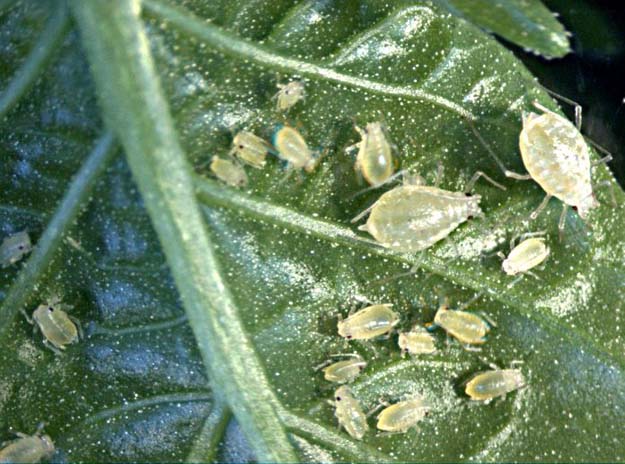
Unfortunately, the next stage in seed starting is always, at least for me, aphids. It starts with a few seedlings looking poorly, maybe with white mottling on their leaves, maybe with shiny sticky stuff on their leaves. If I look closely and under the leaves, I will see the tiny, soft green aphids, sucking the life out of my plants.

Fortunately, aphids are easily killed using a soap solution that clogs their spiracles (breathing pores) and suffocates them. I use the product made by the Safer company, buying it in bulk and mixing it up in a spray bottle as needed. I last bought an $8 bottle 3 years ago and have yet to use half of it. The year I didn't spray I lost my peppers and basil, but the aphids pretty much left the tomatoes alone.

The aphids hang out on the underside of the leaves, so I spray gently and run my hands over the leaves to make sure all parts get wet. The bottle says not to use the soap on jade plants, but aphids don't seem to like jade plants anyway.

That's not one of my photos above. My camera is acting up again but this time I can't fix it with a pencil eraser. the photo came from Plantedoktoren.

Friday, April 04, 2008

I Don't Have A Grow Light


I realized that the last time I wrote about my seed starting project, I used the phrase "grow light."

I don't have a grow light. I have a homemade wooden plant stand with two $10 shop lights mounted under the shelves. It works just fine.
For a while, I really wanted a setup like the one in the picture and I was trying to justify spending $150 on one such light. But when I brought the catalog to work, everyone in the break room said, "Oh, you're going into the dope growing business?"
Then I heard that the neighborhood hydroponic lettuce grower had been robbed. They cut through the side of his poly greenhouse and made off with all the lights. They left the lettuce. I decided that I didn't need to own anything that dope growers wanted to steal, and that the $10 shop lights were working just fine.
I mention this because it is easy to get intimidated by the tons of gardening catalogs and home improvement store ads. You start to think that growing a garden requires a huge monetary investment. I like seed catalogs as much as anyone, but I'm not above picking up seeds from the ten cent rack at Walmart. All of the seeds that I started this year were old, some were even marked for 2003. The arugula and lettuce seeds were harvested from plants that went to seed at the end of last season. Most of our sunflowers are transplanted from the seedlings that come up under the bird feeders.
I'm so pleased with the lettuce and arugula that I've resolved to try more seed saving this year.

Tuesday, April 01, 2008

Dibbling Out

From left: Strawberries, onions. tomatoes, peppers, more tomatoes,and basil.

The next step in seed starting happens when the plants have their first two "true leaves." The first leaves, the cotyledons, were packed inside the seed and popped through the soil. These are plain leaves designed to store energy in the seed and then collect light to convert to energy to feed the growing plant. The next set of leaves are usually more ornate and look like the leaves of the adult plant.

When the true leaves show up it is time to "dibble" the plants out into more spacious pots.

Here we have a row of tomato plants on the left, and a couple of tomatoes already enjoying their new home. Tomatoes are very forgiving of root damage, but you have to take care to pick the plants up by the leaves, not the stems. I water the soil before I start working with it and I water again when I'm done, gently, to make sure there's no air around the roots.

I'm using old pots from years gone by. If I keep them out of the UV light as much as possible they will last four or five seasons. I never buy new pots, I just pick them out of other peoples' trash and wash them well.

My one flat of started seeds is now four-plus flats of seedlings. I'm swapping them out under the grow light and hoping for spring.


Posted by Picasa

Tuesday, March 18, 2008

Thinning the Started Seeds


Before Thinning
After thinning. You can still see a few "trunks".
A small but important step in raising seedlings is to thin them when they start to shade each other out. I thinned the tomato seedlings, with a nail scissors, to about one inch apart. I looked for nice fat stems, not tall plants, as the shorter, stockier ones are stronger.

The basil plants on the right need thinning, too, but I will let them get a little bigger so that I can toss the thinnings into a salad.
Posted by Picasa

Friday, March 14, 2008

Damping Off


Yesterday this tomato seedling was standing tall. Today its stem is shrunken and its top is toppled. It is suffering from a fungus infection that goes by the common name "damping off." I lose a few seedlings to this syndrome every year, but I plant more than I need, so it will all work out. I'm brewing a pot of strong chamomile tea (a cheap natural fungicide), and when it cools I will use it to water the entire tray of seedlings. I will also stop covering the flat at night. The cover worked for the peppers, keeping them warm, but it also made conditions ripe for fungus.
Posted by Picasa

Thursday, March 13, 2008

The Garden Is Growing


But just on one shelf in the house, so far. Those are basil plants in the foreground. The tomatoes are behind them, waiting to be thinned with a nail cutting scissors. The peppers are slower. The jalapeno types are showing just a little green above the soil but the bell types are still just lying there. The heat mat under the flat helps to get the peppers going.

There are a few rows of onions and leeks and then the alpine strawberries. The green field in the background is a cake pan full of lettuce and arugula. I'll be cutting that by Easter, for some fresh greens.

The snowplow came by again this morning, to scrape off the three inches of frozen junk that fell last night. I can't wait to dig in the ground.
Posted by Picasa

Wednesday, March 05, 2008

Tired Of Winter

>
Posted by Picasa
We're all tired of snow, but the animals are doing something about it. The red squirrel and the grey squirrel are both done hibernating and back to raiding the bird feeders. Our cats and the dog are back to chasing the squirrels; the cats are coming close to success.

The tracks in the snow tell stories all over the yard. Above we have the dog's big tracks, a cat's smaller tracks. and the tiny tracks of a mouse that came out from under the lilac and wandered in skittering paths all over on top of the snow.


I'm doing something about the snow, as well. This is a flat of lettuce and arugula, planted from the seeds of last year's crop. I'm growing them under lights and in the window on sunny days for cutting greens. They were doing well until Shelagh and Jordan brought their cat home for spring break. He found this flat to be a fine place to curl up in the sun. and watch all the action in the yard.

I try to plant peas on St Patrick's Day, but this year it seems unlikely. Lettuce, radishes, carrots, peas, and parsnips will go in as soon as the ground thaws; a little snow won't hurt them as much as the hot sun of June does. I will have a few of last year's parsnips to eat as soon as the ground thaws and they will be a treat.

Tuesday, March 04, 2008

First Plantings

Posted by Picasa
This is an alpine strawberry seedling, one of the first things I planted for the 2008 garden. These tiny seedlings will grow into small strawberry plants that bear fruit, small intensely flavored strawberries that kids love to find and eat.

I started these a few weeks ago in paper towels, but I had to have Anna tell me if the roots had emerged because the seeds are so small. I planted them onto trays with vermiculite over soil, but they were so hard to see that I wasn't sure if I was planting them or smooshing them. A few days ago I saw tiny green leaves so I knew they were growing.

Tonight I planted peppers, tomatoes, and basil, It seems early, but I never seem to get ahead of myself, especially with peppers. Come May 10th, we may be tripping over plants everywhere, but I'll worry about it then.