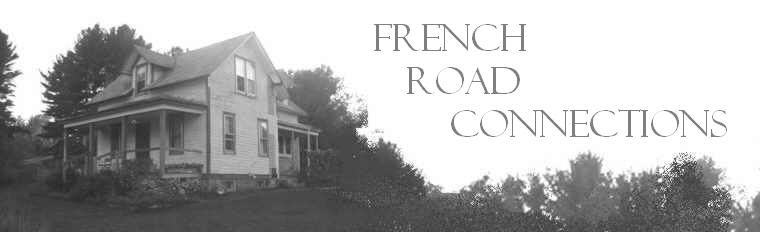
Twenty years in the old farmhouse on the corner, raising kids, growing gardens, keeping chickens. I am a mom, wife, neighbor, casino dealer, 4-H leader, township trustee. What does it mean to be "place literate"? Read on and see...
Showing posts with label books. Show all posts
Showing posts with label books. Show all posts
Thursday, February 11, 2010
High Heat
Brother Tim, stuck at home in DC's snow storm, put together this video trailer for his new book, High Heat.


Friday, May 22, 2009
My Brothers Launch a New Book

So these days I have a Google news alert set up to keep track of my siblings. Good thing, too, because I'm too busy getting the garden in to do much writing of my own. Today's alert tells me that Brothers Chris and Tim's long time project, a coffee table book about the heyday of the Buffalo Braves basketball got a nice review in the Buffalo News. The review also mentions the demolition of the old Memorial Auditorium, the big venue for sports, concerts, etc. of my youth.
I can see it from the third floor of The Buffalo News, a crumbling carcass of steel and brick. You think of the ghosts and memories contained in the old Memorial Auditorium, and in the hearts and minds of the athletes and fans who spent so many hours there.Buffalo, Home of the Braves is published by Sun Bear Press, brother Chris's new publishing company. Chris is a small business consultant for the the NorthWest Michigan Council of Governments; starting a publishing company is his response to Brother Tim's frustration with the state of the publishing industry, and the opportunity offered by new print-on-demand technology.Tim Wendel remembers. Wendel grew up in Lockport. He came of age in the 1970s, when pro sports in Buffalo were at their zenith and two daily newspapers were there to record the moment. Wendel would run out of his house on cold winter mornings to pick up the old Courier-Express, and to see what Phil Ranallo had to say in his column.
Wendel went to Syracuse to learn journalism. He got work as a sports rewrite guy at the Courier, editing Ranallo's stuff. He was on his honeymoon in September 1982 when he got a phone call from a friend who was watching his apartment. Your apartment's fine, the friend said, but your paper closed.
He ended up in Washington, D.C., where his wife got a job with the Post. Wendel wrote a book about the 1980 U.S. Olympic hockey team. He covered baseball and wrote a baseball novel about Fidel Castro.
He remained a Buffalo guy at heart. He and his brother, Chris, sat around at family gatherings, rehashing games from their youth. One day, they were carrying on about the Braves when a relative said, "Why don't you guys shut up and write about it?"
Tuesday, November 18, 2008
Wildfires as Weapons
We had a wildfire up on Popp Road last week. It burned about 50 acres and threatened our friends' home and farm. In the end, with all county fire crews responding, it was contained and our friends lost only their woods and a row of peach trees. I didn't think that the fire danger was that extreme, but the source of the fire, a brush pile, seems to have smoldered for a week or more until the wind shifted to the east and whipped it up again.
I can't imagine how it feels to live in dry country when the wildfires come up and move fast. This was the terror that the Japanese wanted to turn on the US during WW II, using a simple, ancient, but remarkably effective technology -- paper balloons capable of drifting across the Pacific on the jet stream and then igniting wildfires when they hit the dry land. The fire balloons were kept secret by the US government, both to prevent fear in the US and to deny the Japanese any evidence that their plan was working. But it did work surprisingly well -- over 300 fire balloons landed in the US, one nearly reaching Detroit.
My brother Tim found this WW II training film in the National Archive and posted it with comments about the research for his new novel. Red Rain, based on the stories of the fire balloons. He first heard of the fire balloons while working on a fire crew when he was in college, and he incorporates some of his fire fighting experiences into the story.
Getting the film from the National Archives was, in Tim's words, "Another adventure."
Tuesday, September 09, 2008
Notes from Bill McKibben's Traverse City Talk
About halfway through McKibben's talk it dawned on me that I had posted, last fall, parts of his essay entitled Climate Crisis in National Geographic magazine. I quoted from it with abandon because I so admired his calm way of talking about a situation that tends to overwhelm people into ignoring or denying it. I also admired his ability to break this big problem down into manageable pieces.
The word "connections" is in the title of this blog because I'm usually quite good at connection ideas from many different sources. But I've been overworked this summer. I knew I wanted to go see Bill McKibben, and so did Liz. I wrote a rather lame announcement of his appearance, forgetting that I could have quoted myself from a year ago.
Back then I described how the people around me were living in two different worlds:
Most folks seem to recognize that the world is getting warmer, and that something needs to be done. I have seen the average size cars in the parking lot shrink. I am seeing people considering relocating to be closer to work, or looking for jobs closer to home. Nobody brags about their new snowmobiles anymore. I also have small, concerned conversations with people who are worried about the future but unable to figure out the best way to prepare for change or to shoulder their responsibility.Watching the Republican convention last week was truly watching another world. While most of the people I talk with are looking for strategies for using less energy, the people chanting "Drill, Baby, Drill!" on the floor of the Republican convention seemed to think that finding more oil to burn would automagically fix everything.
McKibben's talk was calmer, more thoughtful, and much more grounded in everyday reality. McKibben has a quiet, everyman persona, much like talking to one of my more reticent neighbors. He has a habit of rubbing the back of his head as he formulates his thoughts, much like a farmer swatting flies away with his tractor hat. He used a lot of self-deprecating humor; it was interesting to me that after a while the women were still responding to these jokes but the men were silent.
He spoke of two different worlds. He described the mood in the world of climate scientists as "terrified" and related the new evidence that suggests that climate change is progressing faster than most had believed possible. He described the response in the world of policy making that was basically no response at all, and told the story of a walk across Vermont that eventually included about 1000 people meeting in the capital and asking their elected leader to pledge support for a goal of an 80% reduction of greenhouse gas emissions by 2050.
"80% reduction of greenhouse gas emissions by 2050" is included in Obama's platform. (McCain's goal is 66% by 2050). Nobody was talking about any goals fro 2050 before McKibben and his friends started walking. This was one of his main points -- that regardless of how cynical the American people have become about the political process, the process can still be made to work.
McKibben's new goal is to publicize the number 350. He wants the world to embrace a target of 350 parts per million of carbon dioxide in our atmosphere, the number that we need to attain in order to stop the course of dangerous climate change. Before the industrial revolution, before we started burning large quantities of fossil fuels, the Earth's atmosphere was about 280 parts per million of CO2. This year, in 2008, the number is 387 and gaining every year.
How do we do this? McKibben spoke of how we keep looking for a "silver bullet" that will fix things without too much individual effort. We tried that approach with ethanol, and the results have not been good. He introduced a new metaphor: "silver buckshot" to describe the many smaller changes that are going to add up to the change we need:
Make no mistake--getting back to 350 means transforming our world. It means building solar arrays instead of coal plants, it means planting trees instead of clear-cutting rainforests, it means increasing efficiency and decreasing our waste. Getting to 350 means developing a thousand different solutions--all of which will become much easier if we have a global treaty grounded in the latest science and built around the principles of equity and justice. To get this kind of treaty, we need a movement of people who care enough about our shared global future to get involved and make their voices heard. ( from 350.org)The video at the top of this post is part of the international effort to publicize the 350 goal worldwide. The is more of an explanation of this effort at www.350.org. McKibben was enthusiastic about the potential of using the internet to organize a worldwide citizens' movement, saying "If there is a reason for the internet, if God decided that humans needed to create the internet at this point in history, it is surely so that we can use it to solve the climate crisis, the most dangerous problem we have ever faced."
I think that we are not facing this problem because we are scared. We have amped up our our economy on cheap energy for so long that we fear that no more cheap energy means, as one audience member put it, "a return to the horse and buggy days." McKibben cited surveys in which Americans have been asked, every year since 1956, how happy they are. Every year since 1956 we report that we are less happy, even though our consumption of material goods has increase threefold since then. McKibben spoke of how our bigger homes, spread out across the landscape and the miles of roads to connect them all have left us all more isolated and lonelier.
Bill McKibben's new book is Deep Economy, The Wealth of Communities and the Durable Future. His premise is that rebuilding our communities is neccesary for both energy efficiency and to reach the sense of well-being that we have been seeking, but not finding, through our last half century consumption binge. While I'm skeptical of uniform measures of happiness, I find such satisfaction in the nuances of community that I'm interested to read the new book.
Bill's Traverse City talk can be heard online here.
Sunday, August 31, 2008
Red Rain

Brother Tim's historical novel Red Rain debuts next week.
Tim Wendel’s RED RAIN tells the story of the best-kept secret weapon of World War II – the Japanese fire balloons.You can join me in reading chapter one on Tim's website.
Assembled from paper by schoolchildren and women in the waning years of the war, these curious weapons were launched from fields near Tokyo and Kyoto. They often reached the U.S. mainland in just three days and two nights. Armed with incendiary bombs, the balloons’ original goal was to ignite forest fires throughout the western states, which they did at an alarming rate. Wendel’s research at the National Archives and the Smithsonian in Washington, D.C., reveals that the balloons touched down in the U.S. more than 300 times from 1944 to 1945.
The balloons proved to be a better weapon than the Imperial Army ever knew. One sailed as far east as Michigan. At one point, the Japanese high command planned to replace the incendiary bombs with nerve and gas warfare. But, thankfully, it never came to that largely because of the U.S. military’s ability to keep a secret.
Wednesday, April 09, 2008
Bradley on the Role of Citizen
From Bill Bradley's The New American Story:
This was just one of many passages in Bradley's book that resonated with me. His method is to look at each of the major issues facing Americans and reiterate the "story" of that issue as we have become used to hearing it, then to retell the story of that issue in a new, more hopeful way.
He addresses world politics, the economy, oil and the environment, pensions, health care, and education. While I don't agree with him on every point of analysis, his perspective is far reaching and thoughtful. This book hit by library shelf in April 2007, but is almost eerily predicts the current meltdown of the housing market, sub prime mortgages, hedge fund market, and the fall of the dollar.
It would seem like he was a lone voice in the wilderness if I didn't hear so much of Bradley's ideas in reflected in this year's competition for the Democratic nomination, in Governor Granholm's alternative energy initiative, in the AARP ads featuring the purple elephant-donkey.
Once you have a desire to make a difference and you've taken steps to be informed, the next step is to get involved, passionately. Socrates captured this spirit of involvement during his trial, when he was faced with the prospect of exile from Athens: "Perhaps someone may say, 'But surely, Socrates, after you have left us you can spend the rest of your life in quietly minding your own business,' this is the hardest thing of all to make some of you understand. If I say that....I cannot 'mind my own business' you will not believe that I am serious." Inherent in the job of being a citizen is the refusal to mind one's own business. As a citizen, you are the caretaker of the public good. You don't see yourself as a representative of a special interest, and you don't think democracy amounts only to a negotiation among special interests. You are disinterested; you act for the whole, not just yourself.
Such engagement will not be easy. It goes against the prevailing idea of how things ought to be done. In Unconscious Civilization, John Ralston Saul writes that being a citizen is "not a particularly pleasant or easy style of life. It is not profitable, efficient, competitive or rewarded. It often consists of being persistently annoying to others as well as being stubborn and repetitive." But when you keep at it, beautiful things can happen. Like Socrates, we need to challenge the public lies that too often pass without comment and explain what it means to be a democracy committed to humanism and globalization simultaneously. Our own philosophers, economists, political scientists, and sociologists should engage on the public issues of the day, not just hole up in their academic sanctuaries. Democracy depends on citizens who make waves. When citizens abdicate their inherent democratic power, they turn the system over to those who often use it for personal enrichment, or worse. A true citizen doesn't retreat to his or her private pleasures when the price of public silence is that society's big decisions are made by fewer and fewer people.
This was just one of many passages in Bradley's book that resonated with me. His method is to look at each of the major issues facing Americans and reiterate the "story" of that issue as we have become used to hearing it, then to retell the story of that issue in a new, more hopeful way.
He addresses world politics, the economy, oil and the environment, pensions, health care, and education. While I don't agree with him on every point of analysis, his perspective is far reaching and thoughtful. This book hit by library shelf in April 2007, but is almost eerily predicts the current meltdown of the housing market, sub prime mortgages, hedge fund market, and the fall of the dollar.
It would seem like he was a lone voice in the wilderness if I didn't hear so much of Bradley's ideas in reflected in this year's competition for the Democratic nomination, in Governor Granholm's alternative energy initiative, in the AARP ads featuring the purple elephant-donkey.
Tuesday, March 25, 2008
Far From Home
There was a nice review of Brother Tim's new book, Far From Home in the Wall Street Journal today:
This book broadly portrays the various Latino waves in Major League Baseball and contains many brief historical sketches, including a page about an early Washington Senators super-scout, "Papa" Joe Cambria. He worked the Latin America beat in the late 1930s through the 1940s, signed numerous Latinos, and possibly even scouted Fidel Castro.Tim has three books coming out this year, at least by my count. You can read about them on Tim's home page.
"Far From Home" contains over 100 photographs, including a poignant photo-essay by co-author José Luis Villegas. His subject, from a series of photos taken in 1996: two Oakland A's prospects, Dominicans Miguel Tejada and Mario Encarnacion. Mr. Tejada, the lesser-regarded of the two prospects, morphed quickly into a star for Oakland and now plays for the Houston Astros. Mr. Encarnacion kicked around various second-tier leagues and died in 2005 at the age of 30 from a congenital heart condition.
The final pages of the book include a portrait gallery of a dozen-plus Latino stars, including pitchers Fernando Valenzuela, the first player to win rookie of the year and Cy Young awards in the same year, and Juan Marichal, who wrote this book's introduction. These portraits are an appropriate homage, as it is these and dozens of other Latino all-stars who have boosted Major League Baseball.
Thursday, January 31, 2008
Snow Day
It was a storm for a perfect snow day. When we went to bed, it was still around 40 degrees. In the morning it was minus 3. The wind kicked up in the night, sending the last frozen slabs of snow skittering down the roof with the biggest gusts. I laid in bed, wondering what was happening to my new roof.
Richard shovelled the driveway with the big scoop instaed of running the snowplow. He needed the physical activity to stay warm. Still he had a few times when he blinked and his eye froze shut, so he had to go into the shop to warm up.
I'm reading Joseph Bruchac's The Dark Pond to Anna. I wanted to read her Dawnland, Bruchac's epic about prehistory couple with a primer on dog/human relations, but the book was culled from the Leland Library a few years ago because it was infrequently checked out. Now it seems to be out of print.
The wind died as the day went on, so I ended up going to work last night, where there were a few hardy souls to entertain. This morning the sun is out and the wind has calmed, so Richard is on the ice seeing if the fish will bite.
Richard shovelled the driveway with the big scoop instaed of running the snowplow. He needed the physical activity to stay warm. Still he had a few times when he blinked and his eye froze shut, so he had to go into the shop to warm up.
I'm reading Joseph Bruchac's The Dark Pond to Anna. I wanted to read her Dawnland, Bruchac's epic about prehistory couple with a primer on dog/human relations, but the book was culled from the Leland Library a few years ago because it was infrequently checked out. Now it seems to be out of print.
The wind died as the day went on, so I ended up going to work last night, where there were a few hardy souls to entertain. This morning the sun is out and the wind has calmed, so Richard is on the ice seeing if the fish will bite.
Sunday, January 27, 2008
Obama
When I read The Audacity of Hope last year, I was impressed. It was hard to admit that I was impressed; after all this guy was obviously ambitious, and since he was running for president, he would soon be sucking up to this or that interest group, contradicting himself from one week to the next, because that's how you get elected. Or he could be a sideshow candidate, true to his principles with a minuscule following.
Still, The Audacity of Hope was an impressive book. The Republican library volunteer sneered as I checked the book out, saying "Do you think he wrote it himself?" As I dug into it, I was sure he wrote it himself, since a publicist would have gutted the lectures on the constitution and the debates about the Founding Fathers' intentions and included many more heartwarming anecdotes in the manner of the Lifetime Channel.
What the publicist would not have known, what I didn't know, was that my heart was yearning to be lectured to by someone who knew intimately and revered our Constitution for the treasure that it is. When I came to the 27 pages of the book that detailed the history of US foreign policy from 1776 to the present, I was smitten. To think of all of that history as a single narrative, then to write it coherently in a mere 27 pages, was genius!
But geniuses don't get to be president. It's one thing to write well and another thing to win elections. It was Obama's victory speech in Iowa that sold me. Even then, I felt sheepish. Liz and Brendan watched the speech on YouTube with me, and I said, "Well, just being able to give a good speech doesn't mean he'd be a good president."
They laughed. "We've already seen what the guy who can't speak in public could do! Let's elect Obama!"
I do evaluate candidates on the basis of their stands on the various issues. But their stances aren't all that different, and my two big issues -- "How do we address climate change?" and "How do we get our Constitution back?" --aren't front and center in the debates. What my two issues have in common is that they require all of us to make some sacrifices for the common good, and Obama is the only one who is challenging us to do just that.
I did not travel around this state over the last year and see a white South Carolina or a black South Carolina. I saw South Carolina. I saw crumbling schools that are stealing the future of black children and white children. I saw shuttered mills and homes for sale that once belonged to Americans from all walks of life, and men and women of every color and creed who serve together, and fight together, and bleed together under the same proud flag. I saw what America is, and I believe in what this country can be.That's a piece from Obama's victory speech in South Carolina. He uses the word "you" a lot, challenging people to step up, throw off the cynicism, and get to work.
That is the country I see. That is the country you see. But now it is up to us to help the entire nation embrace this vision. Because in the end, we are not just up against the ingrained and destructive habits of Washington, we are also struggling against our own doubts, our own fears, and our own cynicism. The change we seek has always required great struggle and sacrifice. And so this is a battle in our own hearts and minds about what kind of country we want and how hard we’re willing to work for it.
So let me remind you tonight that change will not be easy. That change will take time. There will be setbacks, and false starts, and sometimes we will make mistakes. But as hard as it may seem, we cannot lose hope. Because there are people all across this country who are counting us; who can’t afford another four years without health care or good schools or decent wages because our leaders couldn't come together and get it done.
Watching Obama's speeches on YouTube is a new pastime for Anna and me, a pleasure to look forward to.
Thursday, December 20, 2007
Brilliant Books
Suttons Bay has a new bookstore, Brilliant Books. It is across the street from Misfit Toys with a sweet old-fashioned storefront. The proprietors are Peter and Colleen Makin. I've always enjoyed talking with Peter, and I look forward to getting to know the Makins and their books better.
Brilliant Books is also on the web. As a quick foray into the site, I picked a topic that Liz and I had been discussing, urban planning. (Her environmental studies class was supposed to design the transportation of the future. Her group decided that instead of building better cars, we need to build better cities.) This page from the Brilliant Books site speaks to the same thoughts that Liz and I were sharing. I want to read at least half of the titles on this page alone.
And they are open late on Christmas Eve!
Brilliant Books is also on the web. As a quick foray into the site, I picked a topic that Liz and I had been discussing, urban planning. (Her environmental studies class was supposed to design the transportation of the future. Her group decided that instead of building better cars, we need to build better cities.) This page from the Brilliant Books site speaks to the same thoughts that Liz and I were sharing. I want to read at least half of the titles on this page alone.
And they are open late on Christmas Eve!
Friday, November 16, 2007
"A Global Warning?" on the History Channel
We watched "A Global Warning?" on the History Channel earlier this week. What I liked about it was the way they considered the popular arguments supporting the "global warming is not real" camp. (Sure, there is a cycle of climate change that is driven by the "wobble" in the earth's axis, but according to that cycle, we should be getting colder.)
Of course, it's just TV science, not a substitute for actually reading a book or two on the subject. This year Liz left me The Hype About Hydrogen, by Joseph Romm, an energy a serious look at hydrogen technology and its potential to be the solution to climate change. Although Romm thinks that we must eventually have a hydrogen economy based on the hydrogen fuel cell, it is not going to happen without major technological breakthroughs, and some components, like the hydrogen car, may never happen at all. It matters whether we bet on things like the hydrogen car, because global warming is progressing, perhaps even faster than predicted, and we really don't have time to make silly bets. The part of the book that made the biggest impression on me was chapter 8, in which Romm compares the projected rate of climate change with the projected rate of Hydrogen Technology development. It seems that hybrids really are the car of the future, at least for my generation.
Of course, it's just TV science, not a substitute for actually reading a book or two on the subject. This year Liz left me The Hype About Hydrogen, by Joseph Romm, an energy a serious look at hydrogen technology and its potential to be the solution to climate change. Although Romm thinks that we must eventually have a hydrogen economy based on the hydrogen fuel cell, it is not going to happen without major technological breakthroughs, and some components, like the hydrogen car, may never happen at all. It matters whether we bet on things like the hydrogen car, because global warming is progressing, perhaps even faster than predicted, and we really don't have time to make silly bets. The part of the book that made the biggest impression on me was chapter 8, in which Romm compares the projected rate of climate change with the projected rate of Hydrogen Technology development. It seems that hybrids really are the car of the future, at least for my generation.
Tuesday, November 13, 2007
Chicken Citizen
(Note: Working with videos and Blogger presents some new challenges. When I went back to this post to add the "books" label at the bottom, I didn't wait for the video part to load correctly. When I reposted, the entire post was blank. I've reconstructed it as best I can.)
Al Gore, in The Assault on Reason, asserts that it is the one way nature of television that has propelled the downward spiral of democracy in America, and that the progress of internet technology in allowing everyone to contribute ideas and opinions to the idea marketplace that will eventually lead to a rennaisance of democracy:
Consider the rules by which our present public forum now operate and how different they are from the norms our Founders knew during the age of print. Today’s massive flows of information are largely only in one direction. The world of television makes it virtually impossible for individuals to take part in what passes for a national conversation.
Individuals receive, but they cannot send. They absorb, but they cannot share. They hear, but the do not speak. They see constant motion, but they do not move themselves. The “well-informed citizenry” is in danger of becoming the “well-assumed audience.”
I can't wait. As soon as I read that, I said to myself, "I've got to learn how to post videos!"
This is my first attempt. This is a video of my chickens roaming the yard on a rare sunny November day. The hens are Black Australorps, Partridge Rocks, and Speckled Sussex. The two Speckled Sussex always go everywhere together. The rooster is our "exotic chick" from McMurray Hatchery. We think it is an Egyptian Fayoumis.
You can see my stray grey hair blowing across the lens, and you can hear me breathing. The rooster does a great job of strutting his stuff, you can even see his slate blue feet. I thought he would crow, but he never did.
At the end, the Rhode Island Red comes up and pecks my hand. I don't know why I was so surprised, she does that every time I go in the barn.
Sunday, January 28, 2007
It was fun to read the interview with former French Road neighbor Jim Harrison in the NY Times this week. As always, the Times writer revealed as much about himself as he did about his subject. I was laughing at the video that accompanied the article, when the cameraman shot a long still of Harrison's pack of American Spirits sitting on the table, like they were some sort of key to the mystery of how to be an awesome writer. Later that night, I laughed again seeing a pack of the same brand cigarettes on the corner of a blackjack table. Maybe they are also the secret to awesome double downs.
Although the Harrisons lived up the road from us for many years, I never met Jim. I enjoyed his writing too much to want to meet him, but I sold eggs to Linda and kept an eye out when they were searching for stray dogs. I never really knew that he was a well-known writer until one slow winter night at the casino when I saw guys in scarves walking around. Guys in northern Michigan don't wear scarves unless it's 12 below and blowing forty, and even then they take them off indoors. Eventually one of the guys in scarves sat down at my blackjack table and I asked him where he was from.
"Paris," was the reply. "In France." Like I couldn't figure that out! They turned out to be in town filming a documentary on the cranky writer guy up the road, who was quite well known in Paris. In France. The French guys were very funny gamblers, laughing when they won, laughing even more when they lost, teasing me to use my rusty high-school French. They were not in a hurry, just thrilled to be here.
Cooking gourmet food in an ordinary kitchen is pretty French. Cooking local, homegrown food is pretty French, and it happens a lot on French Road, too. Right now my culinary quest is veering between recreating a Thai basil sauce that I ate four years ago in Soho and finding ways to cook the 3-year-old spent laying chickens ("old biddies") in the freezer. I find myself on sites like Cha Xiu Bao, where the recipe for Chicken and Conch Soup with Honeydew Melon starts out "Get an old chicken -- they have much more flavor."
I won't make this particular recipe, since I have no conch feet, but it's helpful to realize that those tough old birds would be sought after by many cooks. Not American cooks, for whom chicken is a meal that can be prepared and consumed in less than an hour, but slow cooks who remember the old food.
In the NY Times video, Harrison sounds like my Grampa Lee, talking about how most Americans have never fed a chicken or held a pig or petted a cow. Or my husband, when we are slaughtering chickens, complaining that I don't pluck feathers half as fast as his mother did. "Nobody could pluck a chicken faster than my grandma. She'd grab it, dunk it, then pfft, pfft, pfft, she was done and on to the next one!" Someday I might measure up.
Although the Harrisons lived up the road from us for many years, I never met Jim. I enjoyed his writing too much to want to meet him, but I sold eggs to Linda and kept an eye out when they were searching for stray dogs. I never really knew that he was a well-known writer until one slow winter night at the casino when I saw guys in scarves walking around. Guys in northern Michigan don't wear scarves unless it's 12 below and blowing forty, and even then they take them off indoors. Eventually one of the guys in scarves sat down at my blackjack table and I asked him where he was from.
"Paris," was the reply. "In France." Like I couldn't figure that out! They turned out to be in town filming a documentary on the cranky writer guy up the road, who was quite well known in Paris. In France. The French guys were very funny gamblers, laughing when they won, laughing even more when they lost, teasing me to use my rusty high-school French. They were not in a hurry, just thrilled to be here.
Cooking gourmet food in an ordinary kitchen is pretty French. Cooking local, homegrown food is pretty French, and it happens a lot on French Road, too. Right now my culinary quest is veering between recreating a Thai basil sauce that I ate four years ago in Soho and finding ways to cook the 3-year-old spent laying chickens ("old biddies") in the freezer. I find myself on sites like Cha Xiu Bao, where the recipe for Chicken and Conch Soup with Honeydew Melon starts out "Get an old chicken -- they have much more flavor."
I won't make this particular recipe, since I have no conch feet, but it's helpful to realize that those tough old birds would be sought after by many cooks. Not American cooks, for whom chicken is a meal that can be prepared and consumed in less than an hour, but slow cooks who remember the old food.
In the NY Times video, Harrison sounds like my Grampa Lee, talking about how most Americans have never fed a chicken or held a pig or petted a cow. Or my husband, when we are slaughtering chickens, complaining that I don't pluck feathers half as fast as his mother did. "Nobody could pluck a chicken faster than my grandma. She'd grab it, dunk it, then pfft, pfft, pfft, she was done and on to the next one!" Someday I might measure up.
Wednesday, October 04, 2006
My Man Stan
Brother Tim has a new book out. This one is a kids' book about hockey and time travel, centered on Stan Mikita, who played for the Chicago Blackhawks in the 1960's.
The time travel device is simple. When you listen to a game on the Magic Radio, you are transported back in time. Not a lot of sci-fi mumbo-jumbo, and if you doubted that a radio could do this, Tim's powerful descriptions of the hockey action are a handy testament to the power of words to transport the mind.
Both Makita and the young narrator are learning to control volatile tmepers, but the storyline doesn't wander over to preaching. I enjoyed the book as a good read.
Here is a link to My Man Stan. Tim's website is here.
The time travel device is simple. When you listen to a game on the Magic Radio, you are transported back in time. Not a lot of sci-fi mumbo-jumbo, and if you doubted that a radio could do this, Tim's powerful descriptions of the hockey action are a handy testament to the power of words to transport the mind.
Both Makita and the young narrator are learning to control volatile tmepers, but the storyline doesn't wander over to preaching. I enjoyed the book as a good read.
Here is a link to My Man Stan. Tim's website is here.
Subscribe to:
Posts (Atom)