Twenty years in the old farmhouse on the corner, raising kids, growing gardens, keeping chickens. I am a mom, wife, neighbor, casino dealer, 4-H leader, township trustee. What does it mean to be "place literate"? Read on and see...
I haven't posted one of these NOAA Lake Michigan temperature maps this year. I haven't needed to. In a normal December, we are huddled under a couple of week's worth of dark clouds dumping foot after foot of lake effect snow. I monitor Lake Michigan surface temperatures, waiting for the day that the big lake gets cold enough to stop adding its moisture to the cold west winds and the lake effect machine shuts down.
The lake is still warm, over 40 degrees, but the winds didn't blow that way this year. After a few days of melt around Christmas, the wind started blowing from the north, from the east, from the northeast, making for cold and wind but no reason to run the snowblower. The rest of the country is seeing low temps and snow, but we are taking a break and even expecting a thaw next week.
The Leelanau Children's Choir will present its 17th Annual Madrigal Concert at 7:30 on Friday December 4th and Saturday December 5th at the Northport Performing Arts Center. This is a picture of Anna and Liz. This photo is maybe 4 years old; the little girl wearing this costume this year is truly little, Liz is long graduated, while Anna has become a young lady. Tech week is always a grind, but the performances truly start the Christmas season.
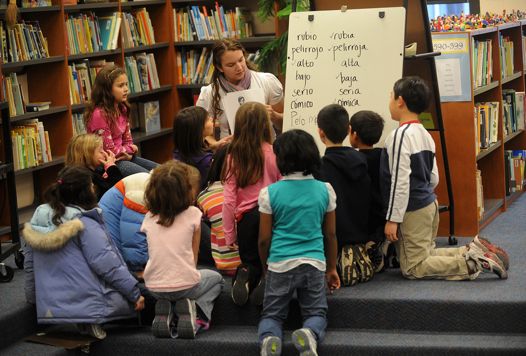
University of Michigan senior Shelagh Fehrenbach works with a group of third graders on Spanish words during a class at Ann Arbor's King Elementary School. Melanie Maxwell | AnnArbor.com
It was a treat to have daughter Shelagh and her husband Jordan home for a short Thanksgiving holiday. My favorite moment was when Shelagh was reacquainting herself with the piano and Beethoven's "Sonata Pathetique" in all its head=banging glory while Jordan and I swept up the kitchen and Anna hovered over Shelagh's shoulder, turning pages and watching music and hands.
We ate a smoked turkey from Carlson's and lots of side dishes. Shelagh and I sort of tag teamed teaching Anna how to make the pies. We burned the first baked pie shell so we had two lemon meringue pies and no apple, but apple is an everyday pie and lemon meringue only shows up when Shelagh comes home, so everyone was happy. I cut up a home grown big Long Island Marrow Squash, roasting part of it in chunks and cooking down the rest for pie filling. Yams with coconut milk and garam masala has been my favorite leftover dish.
Shelagh and Jordan went back to Ann Arbor on Saturday. Shelagh is student teaching in a third grade classroom at Martin Luther King Elementary, hoping to be lucky enough to get a teaching job after graduation, but making plans to work odd jobs until Jordan finishes his degree.
You can read more about the Ann Arbor Language Project here.
Ken Scott's stop action film of the 350 on the dunes.
We had to go to Traverse City anyway, so I told Anna that we would spend the extra fossil fuels to swing by the dunes and join a group of people who were going to make a giant 350 on the dunes to draw attention to climate change. She said "Great!" and asked if her friend Madison could come along.
When we got there, people were sort of milling around and saying hi to each other. It was interesting to try and figure out who was there for climate change and who was there to just visit the dunes. Jim Lively stood on a picnic table, hollered a welcome, explained the event, and then asked us to divide into three groups, one for each digit. I was drawn to the small groups of people picnicking and watching; I made a quick pass down the picnic tables inviting the onlookers to "help us make the number 350 on the dunes as part of an international effort to focus government attention on the challenge of climate change." I knew I probably wouldn't get many takers, but I wanted everyone there to know why we were doing what we were doing.
I'm the person in the teal shirt and dark jeans running to catch up to the last of the "0" group. Anna and Madison were wearing matching neon green T shirts and pink shorts, at the top of the 5. In the stop-action movie it seems like we were rushing, but at the time we had plenty of time for crosstalk, even as we kept our eyes on our director. The lady next to me fretted about people who who coming in late to join. They weren't wearing the bright blues and greens mentioned in the email invitation to the event. "That's OK," we reassured her, "we need all the help we can get." It reminded me of the bickering about "I'm greener than you!" that often pops up in environmentalist circles and discourages neophytes from taking small steps because they can't see themselves going whole hog.
In the movie we are only laying down for a second. In real life we had time to look at the clouds blowing by. A guy to my left started thinking aloud:
"350. That's the percentage of the carbon of what, again?"
I spoke to the sky, "We need to achieve a target of 350 parts per million of CO2 in our atmosphere in order to avoid catastrophic levels of climate change. Scientists agree that 350 is our target."
"And where are we now?"
Across the "0" someone yelled, "We are over 380. Getting close to 390."
An older voice said, "We need to get our governments to get serious about this. We can all do things on our own, but governments need to become involved. A younger voice suggested "Go to 350.org."
We stood up again, on cue, and then jumped up and down and did some waves. I was reminded that I was never meant to be a cheerleader. The elderly lady next to me confessed that she couldn't jump. I said, "I think I'm jumping but I'm afraid that my pants are staying where they were."
We all trooped down again on cue, and then went off to our own pursuits. I fed the girls a picnic lunch and they set off to play on the dunes, the better to justify the extra gas that we had spent on such a frivolous stunt. Usually we come to the dunes when family visits. I was impressed at the discipline of the group that came on the tour bus and dutifully trooped up and down the dunes in a line. I saw many examples of our typical family gathering, when a few people go up and then disappear for what seems like hours while others wait at the bottom wondering if the first group is lost.
I sat for over an hour waiting for Anna and Madison. I talked to the family sharing our picnic table and turned a forgotten video camera over the a park ranger. I fielded questions from people who had seen the 350 and wondered what it was (a family reunion?) I explained that this action was both a precursor to international events being planned for October 24th and a follow up to Bill McKibben's talk in Traverse City last fall, when he saw mentioned on his own dune tour how cool it would be to se folks depict a 350 on that landscape.
Finally we packed up and drove home, getting ice cream bars in Maple City and dropping Madison off at her house. All traces of 350 were gone from the dunes, but Anna and Madison had put two new tracks on by rolling all of the way down.
Two 4-H kids and their lambs, waiting for their turn to show.
The Northwest Michigan Fair opens on Sunday, with the culmination of the 4-H Livestock projects, the 4-H Livestock Auction, taking place on Thursday, August 13th. The 4-H Livestock Auction is an opportunity to purchase high quality, local, home grown animals for meat, for breeding stock, or to add to your laying flock. It is also the place to buy less mainstream meat like goat, rabbit or duck. For those who want to truly know what they are eating, the fair is an opportunity to interview the person who raised the animal, peruse feed records, compare animals, and to see who was deemed the best by expert livestock judges.
Darrel Robinson of the 4-H Livestock Council was kind enough to give me some advice about the action for first timers. 4-H kids will be showing their animals all week (see schedule here) through Wednesday, and will rated for both the quality of their animals and for showmanship (their knowledge of and handling of their animal). Wednesday evening , the eve of the auction, is a good time to walk the barns and talk with the kids about their animals. Registration for the auction is at 8 am on Thursday morning; the auction starts at 9 am. The auction proceeds one specie at a time, beginning with swine. The lineup looks something like this:
Swine Turkeys Ducks Lambs Goats Steers Meat Chickens Production Chickens (layers) Dairy Feeders Rabbits Jr. Beef
There is a free appreciation luncheon for all registered buyers at noon on auction day. Registered buyers also get free fair admission on auction day. Buyers are also publicly thanked in fair and newspaper advertising. If you are interested in bidding on an animal but can't be there for the auction, you may complete a "proxy card" which authorizes 4-H Livestock Council to bid on your behalf. Call 228-6562 to get a buyer's pass or a proxy card.
After the auction, you may choose from five different local processors, who will slaughter, butcher, vacuum pack, and freeze your meat to your specifications. The processors will have their services and prices posted at the auction. Smoking and other specialty processing is available. 4-H will transport your animal to the processor at the close of the fair. (If you wish to take your animals home instead of to a processor, this is allowed.)
Families who have purchased or shared in the purchase of a cow or pig tell me that having a whole animal in the freezer challenges them to find recipes for more than the usual cuts of meat. I've found these recipes in older cookbooks and ethnic cookbooks. Authentic ethnic cooking often requires goat, rabbit or duck, smaller animals perfect for adventuresome cooks with less freezer space.
Buying at the 4-H Livestock Auction is more than just an alternative way to buy food. Last week at the Traverse City Film Fest, I saw Food, Inc. and was inspired to hand out Livestock Auction brochures at the discussion afterward. During the film, the audience murmured and groaned during scenes of animal distress. I was more moved by descriptions of farmers' distress. The cheap meat that we see in the grocery store is made possible by a system that forces farmers to accept higher and higher levels of debt and diminishing levels of actual income. I'm not worried about the future of the factory far. -- the system is unsustainable and will crumble under its own weight -- but I'm worried that as we build more sustainable systems we will face a dearth of young people who know how to actually work with animals. Supporting 4-H through the Livestock Auction is a way to support the next generation of food producers.
The 4th of July is a big holiday in Leland. Our streets are full of residents and summer people, although the split may be 50/50 between residents watching in the parade and residents actually in the parade. My family has been dedicated parade watchers, passing up opportunities to ride bikes, be a piece of the baguette, support candidates and causes, etc., although brother Chris has been known to play his french horn in the one-rehearsal-only marching band.
For me, the big drama was the Eve of the Fourth fireworks. As long as I can remember the fireworks have been held on the Lake Michigan beach, sponsored by the Leland Community Improvement Association. A few days before this year's display, Leland's fire chief, Mike Fandel, met with the pyrotechnic crew at the site and determined that the rising water and late dredging had left us with too little beach to safely host a fireworks display. Chief Fandel offered us an alternate location, at Hancock Park, and presented us with a plan for crowd control and how they would station the fire crew to simultaneously monitor the fireworks dsplay and be ready in case of a need elsewhere in the township.
It was fun to be called to a special town board meeting to "save the fireworks" by approving the new location. It was not so much fun to hear feedback from people who feared that the soccer fields would be ruined, the park would be trashed, or that the parking would become unmanageable.
In the end, the fireworks went off without a hitch. I heard good feedback about the fire department's safety enforcement and event management. The new location, on a hill, meant that the display was visible from many more parts of the township, including most of the north lake , East Leland, and even my house, over the tops of the trees. Many village residents skipped going out to the field and simply watched from their yards, streets, or rooftops. People remarked that it was much more of a family event, instead of the beach front bacchanalia that we had seen in recent years.
NOTE: I've mentioned fireworks enough that the web crawlers are sure to think that it is appropriate for this blog to host home fireworks advertising. In order to put on a fireworks display in Leland Township, you must get special permission from the town board, which involves obtaining a large insurance policy and an event plan approved by the fire chief, you are likely to be ticketed, fined, or worse.
After the fireworks drama, it was nice to have a laid back day in Leland, watching the parade and cooking hot dogs. I tried to get one shot of each entry in the parade, but I ran out of memory just before The Leland Fire Department made their customary second appearance, with some members running around the back streets to not only head up the parade, but to also bring up the rear. Chief Fandel ended up on top of the antique engine, using a not so spry water shooter to sprinkle the kids in the crowd.
 I haven't posted one of these NOAA Lake Michigan temperature maps this year. I haven't needed to. In a normal December, we are huddled under a couple of week's worth of dark clouds dumping foot after foot of lake effect snow. I monitor Lake Michigan surface temperatures, waiting for the day that the big lake gets cold enough to stop adding its moisture to the cold west winds and the lake effect machine shuts down.